Have you ever felt like someone pulled your strings, pushed your buttons, and forced you to lose your cool in a split second? What if you realized that no one possesses the power to make you angry? What if every emotional response you experience is a choice within your total control?
Let’s explore the underlying mechanics of anger, dissect how self-talk dictates our emotional state, and master practical techniques to keep your power during high-tension conflicts.
- Identify the distinct physiological and psychological stages of the Anger Reaction Ladder.
- Differentiate between the four primary modes of expressing anger and evaluate their long-term consequences.
- Construct authentic, non-defensive “I” statements that express primary emotions without escalating conflict.
- Apply thought-stopping and verbal de-escalation techniques to maintain cognitive control in stressful situations.
The Mechanics of Anger: Triggers, Physiology, and the Anger Ladder
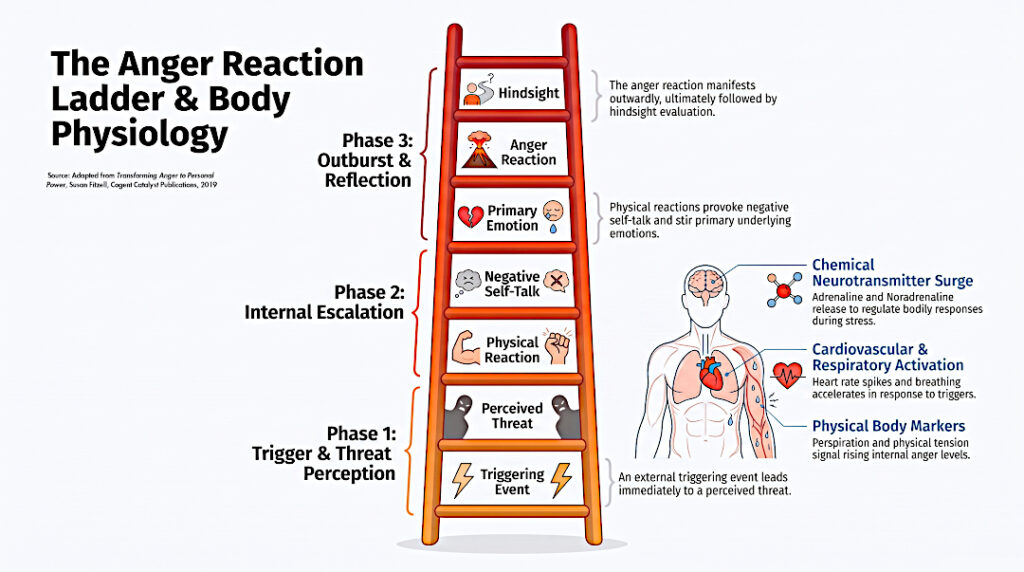
To master anger, we must first demystify how it operates inside our minds and bodies. Anger rarely erupts out of nowhere; it follows a predictable sequence known as the Anger Reaction Ladder.
The Anger Reaction Ladder
- Triggering Event: An external situation or action occurs (e.g., someone interrupts you or makes a sarcastic comment).
- Perceived Threat: Your mind interprets the event as a threat to your dignity, boundaries, or safety.
- Physical Reaction: Your autonomic nervous system kicks in. Hormones like adrenaline and noradrenaline flood your system, causing your heart rate to spike, breathing to shallow, and muscle tension to rise.
- Negative Self-Talk: Internal monologue begins fueling the fire (e.g., “They can’t disrespect me like that!”).
- Primary Emotion: Underlying feelings such as hurt, fear, embarrassment, or feeling overwhelmed rise to the surface.
- Anger Reaction: Anger manifests as a secondary emotion, acting as a defensive shield over the vulnerable primary emotion.
- Hindsight: The aftermath where you reflect on the choices made as well as the consequences, both positive and negative, of that choice.
Primary vs. Secondary Emotions
Anger is a primary emotion when it is an immediate, instinctual response to a direct physical threat, a violation of one’s boundaries, or an immediate injustice.
It’s a secondary emotion when it acts as a protective shield or reaction to an earlier, more vulnerable feeling like hurt, fear, or sadness, for example. There’s still a triggering event, however, it’s pulling up pent up primary emotions that are often repressed until a triggering event. It is vital to recognize that anger is more often a secondary emotion. Think of anger as smoke; the fire burning underneath is usually a primary emotion like feeling hurt, neglected, or scared. When we focus solely on the anger, we address the smoke while ignoring the flame.
Ownership: Triggers vs. Causes
A core principle of emotional empowerment is that no one can MAKE you angry. People or events can only trigger your anger. You hold full ownership and responsibility for how you process that trigger and choose to respond.
The Four Expressions of Anger and Retaining Your Power
When anger is triggered, people generally resort to one of four distinct behavioral styles. Understanding these styles helps us evaluate whether our responses build personal strength or undermine our future goals.
The Four Styles of Anger Expression
- Stuffing It: Suppressing feelings, denying anything happened, or saying “it doesn’t matter” while secretly feeling bad or humiliated inside.
- Escalating It: Feeding negative self-talk, casting blame, seeking revenge, yelling, or resorting to physical violence.
- Handling It Indirectly: Expressing anger through backdoor channels…gossiping behind someone’s back, using passive-aggressive sarcasm, or quiet sabotage.
- Handling It Directly: Speaking assertively, telling the other person clearly and calmly what upset you, and taking personal responsibility without making threats.
How We Give Away Our Power
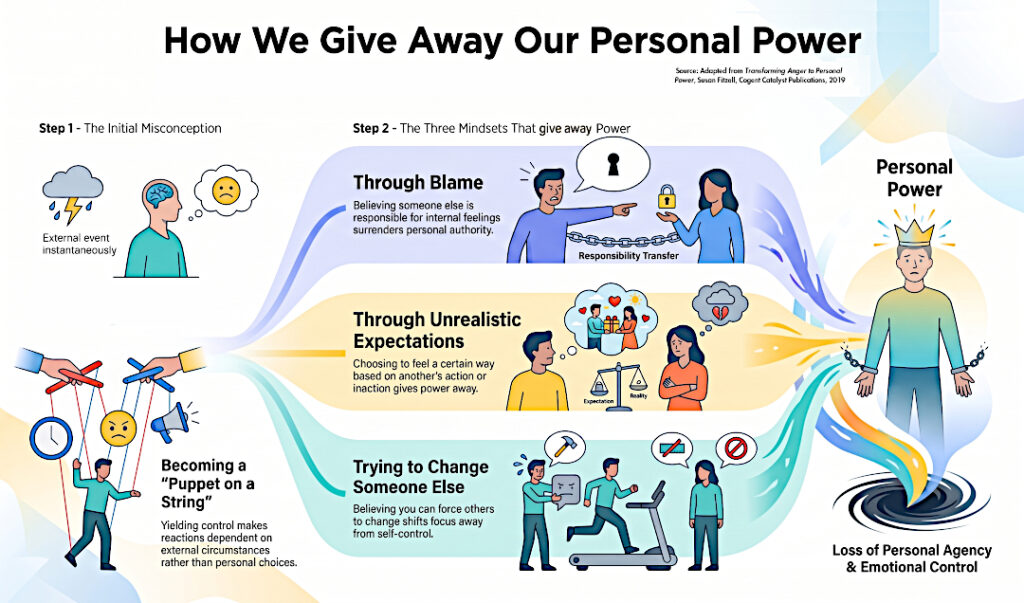
When we react impulsively or defensively, we act like a puppet on a string, allowing someone else to pull our emotional levers. We surrender our power in three primary ways:
- Through Blame: Believing someone else is responsible for our feelings (“You made me furious!”). Blame hands total control of your emotional state to the other person.
- Through Unrealistic Expectations: Becoming enraged when others fail to meet our unspoken rules or expectations.
- Through Trying to Change Others: Basing our happiness or peace of mind on whether another person changes their behavior.
Mastering Assertiveness: Crafting Authentic ‘I’ Statements
Communicating assertively allows you to stand up for yourself without escalating conflict. The most effective tool for assertive communication is the structured “I” Statement.
The Four-Part “I” Statement Formula
When learning to communicate assertively, follow this formula:
- I feel… (Name a primary emotion: e.g., hurt, disrespected, overwhelmed, neglected)
- When… (State the specific, objective behavior or event without judgment)
- Because… (Explain why the behavior impacts or upsets you)
- And I would like / appreciate… (State clearly what you want to happen or change)
Example: “I feel disrespected when you interrupt me while I’m presenting, because it makes me lose my focus, and I would appreciate it if you let me finish before commenting.”
Common Pitfalls to Avoid
- Disguised “You” Statements: Avoid starting with “I feel that you…” or “I feel like you…”. These phrases are aggressive criticisms in disguise and will immediately provoke defensiveness.
- Using Anger Words: Try to avoid using the word angry or slang equivalents in your “I” statement. Expressing primary feelings like overwhelmed or ignored invites empathy, whereas stating “I am angry” causes the listener to shut down.
The Power of Asking Questions
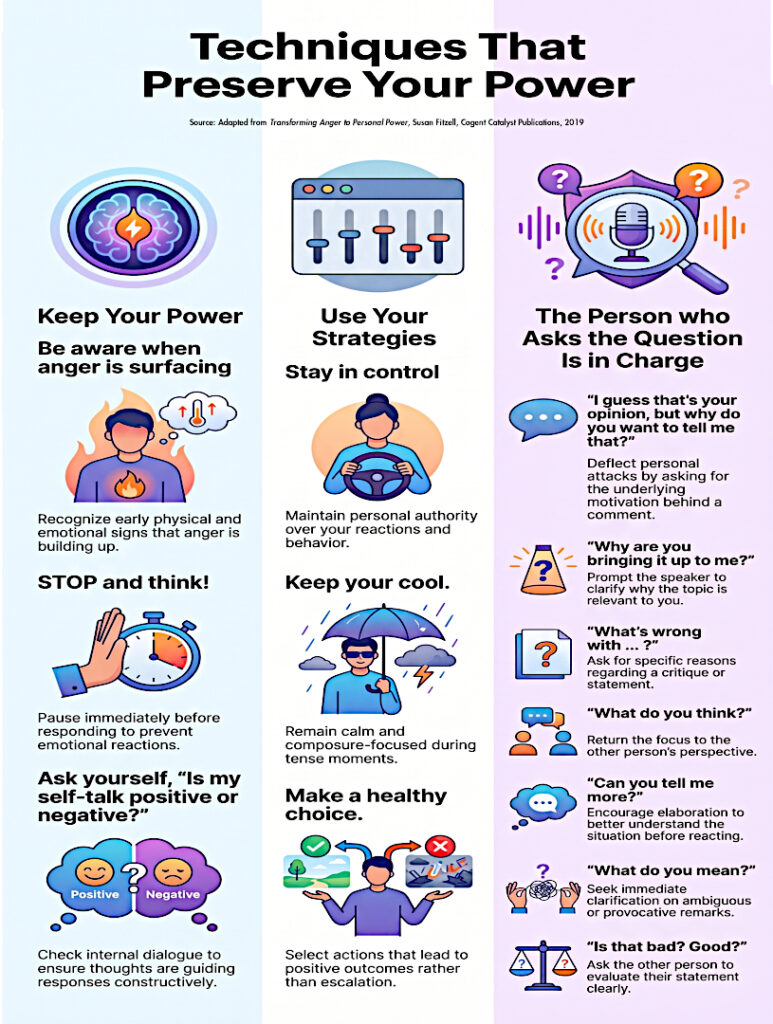
Remember this tactical rule in verbal exchanges: The person who asks the question keeps the power. Instead of defending yourself when attacked, ask calm, probing questions such as “Why does that bother you?” or “What makes you say that?”
Emotional Regulation: Thought-Stopping and De-Escalation Tactics
When anger begins to surge, obsessive negative self-talk often acts as fuel on the fire. To interrupt this runaway cycle, you must employ active cognitive control strategies like Thought-Stopping.
The 4-Step Thought-Stopping Technique
- Become Aware: Catch yourself obsessing over a conflict or playing violent scenarios repeatedly in your head.
- Stop and Think: Pause immediately and act as a neutral “thought detective.”
- Interrupt the Thought: Deliberately distract your brain. Whisper or firmly think “STOP! I am keeping my power!”, snap an elastic band gently on your wrist, or visualize a bright red stop sign.
- Substitute Positive Self-Talk: Replace the obsessive thought with constructive phrases such as:
- “I can handle this!”
- “My time and energy are worth more than this!”
- “Fighting isn’t worth the price I will pay.”
Throwing a Curveball: Unexpected Verbal Responses
When confronted with deliberate teasing, taunting, or intimidation, trick the instigator by doing the unexpected (throwing a curveball):
- Smile and nod calmly.
- Agree with part of the statement (e.g., Instigator: “You have a chip on your shoulder cause you’re short!” -> You: “Yes, I am short.”).
- Pretend it’s a compliment and reply “Thanks for noticing!”
- Call a time-out and walk away with your head held high, shoulders back, and eyes forward.
Summary
Mastering anger is not about suppressing your emotions or pretending nothing hurts; it is about taking full ownership of your reactions so that no one else can dictate your state of mind.
Key Takeaways
- Anger is Secondary: Anger is a secondary emotion shielding primary feelings like hurt, fear, or feeling disrespected.
- Triggers vs. Causes: Other people’s actions are merely triggers; you choose your internal state and response.
- Power Retention: Blame, unrealistic expectations, and attempting to force others to change surrenders your personal power.
- Assertive Formula: Effective “I” statements express primary emotions and clear requests without attacking the listener.
- Cognitive Control: Thought-stopping techniques and curveball tactics disarm conflict before it escalates into violence or regret.
Frequently Asked Questions
What are effective anger management techniques?
Effective anger management techniques include identifying triggers, recognizing physical warning signs, interrupting negative self-talk, using calming or thought-stopping strategies, and choosing an assertive response instead of reacting impulsively. The goal is not to suppress anger but to slow the reaction long enough to make a deliberate choice.
How can “I” statements help de-escalate conflict?
“I” statements help communicate concerns without immediately blaming or attacking the other person. A useful structure is to identify how you feel, describe the specific behavior or event, explain why it affects you, and clearly state what you would like to happen next. This can reduce defensiveness and keep the conversation focused on resolution.
What can I do when anger starts escalating quickly?
When anger begins to escalate, first notice the physical and mental warning signs. Pause, interrupt the negative self-talk, use a thought-stopping phrase, and replace the escalating thought with a calmer, more constructive one. Walking away temporarily, asking a neutral question, or using a brief de-escalation technique can also help you regain control before responding.
Source: Adapted from Transforming Anger to Personal Power, Susan Fitzell, Cogent Catalyst Publications, 2019
Educators:
This video offers advice on dealing with student anger.
 | CLICK HERE to discover more about Susan’s Anger Management work!. Bring Susan to your organization! |