For many of us, the first time we start talking about inclusion is after someone we care about has a brain injury or stroke. We are suddenly catapulted into a reality we don’t fully understand. Suddenly, we have to figure out what to do to survive and thrive in real life with a brain injury.
We are faced with challenges that were never an issue before. Like, what do we do when the room is too noisy? Or, when the words won’t come out right? And, how do we deal with our new reality when a task that used to be simple now feels like too much?
These moments aren’t rare. In my work with teams and families across the country, I hear the concern that people want to help but don’t know how. That matters because adults who become differently wired after a brain injury or stroke can feel very alone. The reason is not only the injury and its impact on their lives, but also how other people respond to it.
Sometimes the barrier to getting the supports needed isn’t a lack of caring, it’s a lack of understanding.
So, what’s the answer? There isn’t a silver bullet. I wish there was. The truth is that there is no one-and-done strategy. There’s no ready-made list of best practices or one-size-fits-all solutions that you can check off and put away. What helps the most is small, consistent, respectful action. We need the kind of support that says, “I’m willing to learn what works for you, and I’m willing to adjust.”
Here are some practical places to start.
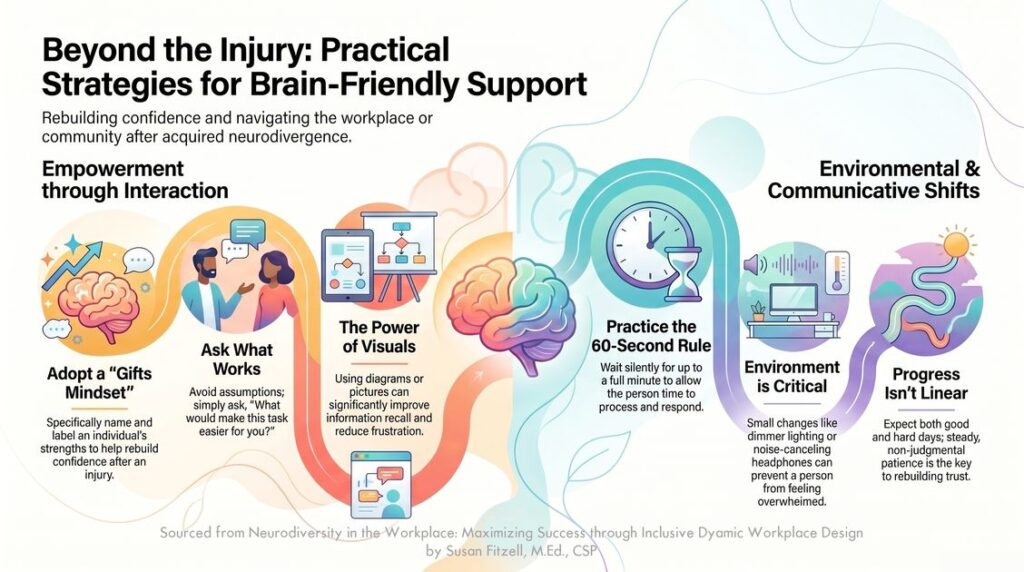
Rebuild Confidence by Identifying and Celebrating Strengths
After a brain injury, it’s natural to focus on what’s harder now. That’s part of the picture, but it’s not the whole picture. People still have strengths. Sometimes those strengths show up in new ways.
I’ve seen people become more patient listeners because they understood, in a very personal way, what it feels like to need time. Name the strength: “I appreciate how well you listen to your colleagues, employees, or mentors.” We tend to gloss over strengths and focus on deficits. Instead, notice a person’s strengths and label them specifically. Confidence comes back one a little bit at a time when employees with acquired neurodivergence are recognized for what they do well. I call this practice having a “Gifts Mindset.”
I learned the profound power of this kind of patient listening from a middle school student named Jimmy. I was called in to evaluate him because he was struggling in all his classes and acting out in frustration, disrupting the learning process for everyone. Part of my evaluation process is to interview the student. I sat down with him one-on-one and established a rapport. I acknowledged his struggle in school and asked him what he would do differently if he were the teacher.
His response was simple, yet it left me gobsmacked. He said, “I would draw pictures on the board”. He honestly explained that he loved science, but when his teacher just talked and wrote notes, he couldn’t grasp it. He needed to see pictures to remember. He added, surprised, “Thanks for asking me what would help me. I wish my teachers would do that.” He was so excited that he jumped up to the board and showed me with drawings how he would teach the science lesson in his class that day.
I shared Jimmy’s feedback with his teaching team, and after our discussion, the teachers began incorporating diagrams and visuals into their lectures. I held my breath as I asked the following question in a follow-up with the team. To my joyful surprise, his teachers said his behavior improved 100 percent. They were amazed at the difference it made. The pictures helped Jimmy relate to and recall the information. The true catalyst for his newfound confidence, though, was that someone finally took the time to ask him what he needed, to listen patiently, and to respect his answer.
This concept is no different in the workplace. Jimmy’s story perfectly illustrates that if an employee is struggling, managers can simply ask them about their perception of the issue and how they can be supported. Ultimately, there is very little difference between what a student needs and what an adult needs to be a successful learner. When leaders take the time to ask what their employees need rather than making assumptions, they foster an inclusive culture where confidence and high performance can thrive for all employees.
Ask What Support Would Make Things Easier
Avoid making assumptions. This is more difficult than it sounds because humans are wired to make quick judgments about their experiences. For example, a manager once publicly called out an engineer for wearing headphones during team meetings, assuming he was listening to music. In reality, the engineer was using them to block out background noise so he could actually hear the manager better. One person may struggle with noise. Another may struggle with visual clutter. Someone else may need written directions, a quieter break space, or a few extra minutes to respond.
Imagine the difference it would make if we just asked our employees, “What would make this easier for you?” Then listen to the answer. Sometimes the answer might be a small change in routine or the option to wear a headset to block out noise. Maybe they’ll ask for a standing station, or for requests to be written down and shared ahead of time. Small changes can make a big difference.
Give People Time to Process and Find the Words
When words don’t come easily, conversation can become stressful very quickly. It’s tempting to jump in, finish a sentence, or try to move things along. Most of the time, that doesn’t help. For example, one of my colleagues described the intense effort required to process and participate in workplace conversations. She explained, “I have to mentally rehearse what I want to say. But even then, I’m spoken over, misinterpreted, or worse, ignored!”
Have you ever asked a question and then silently counted to sixty before expecting an answer? 60 seconds can seem like a long, awkward eternity. Yet, that’s exactly what some people need to find the right words to express themselves. Even when it takes longer than expected, the wait may be well worth it. The goal isn’t speed. The goal is to communicate with dignity and allow a person’s brilliance to shine.
Reduce Environmental Barriers That Make Daily Life Harder
The environment matters more than most people realize.
Bright lights, crowded spaces, constant interruptions, background noise, and unpredictable schedules can turn a good day into a hard one.
Simple adjustments might help. Consider dimmer lighting or providing a quiet space to work as a strategy to deal with interruptions before things become overwhelming.
Be proactive. Instead of waiting until someone is struggling to ask what they need, build that kind of check-in into the way you work with people.
It’s good for everyone. It’s critical for differently wired brains.
Expect Good Days and Hard Days During Recovery
Recovery and adjustment aren’t straight lines. There will be good days. There will be hard days. There will be progress, and there will be setbacks.
That’s real life.
What matters is how we show up for each other. We show up without judgment. We stay steady. We adjust when something isn’t working. We don’t take over when a little support is enough. We don’t disappear when things get difficult.
That kind of patience helps rebuild trust.
These ideas aren’t just for professionals or caregivers. There are ways of being with people that help them rebuild their confidence, sense of purpose, and sense of belonging at work, at home, and in the community. If you’re a leader, counselor, employer, family member, or friend, you have more influence than you may realize. You can set a tone that makes it safe to be honest. You can make room for trial and error, thereby creating a place where people aren’t defined by what’s harder for them now.
In the end, the most powerful thing we can do is see the whole person, not just the injury. After a brain injury, people may need new strategies, adjusted environments, and time to rebuild confidence. When we make daily life and work more brain-friendly, we help people reconnect with their strengths, their purpose, and their future.
By Susan Fitzell, M.Ed., CSP.
1388 words. Download the Word Document for your staff or publication.
If used online, attribution with a link back to the original article on my website is appreciated.
Suggested attribution:
Susan Fitzell, M.Ed., CSP, is a speaker, author, and consultant who helps organizations create brain-friendly workplaces where more people can succeed. Her latest book is “Neurodiversity in the Workplace: Maximizing Success through Inclusive Dynamic Workplace Design.”
FAQ
The most helpful support varies from person to person. An adult may benefit from written instructions, fewer interruptions, a quieter workspace, adjusted lighting, predictable routines, or additional time to process information. Rather than making assumptions, ask, “What would make this easier for you?” Small, respectful adjustments can make daily life and work more manageable.
Employers can support an employee after a brain injury by communicating openly, identifying workplace barriers, and making reasonable adjustments based on the employee’s individual needs. This might include reducing background noise, providing information in writing, allowing extra processing time, or modifying routines. Regular check-ins can help determine what is working and what needs to change.
A brain injury can affect how quickly someone processes language, organizes thoughts, or finds the words they want to use. Rushing the person, finishing their sentences, or speaking over them may increase frustration. Giving them time to think and respond supports clearer communication while protecting their dignity and allowing their ideas to be heard.
A brain-friendly environment reduces barriers that can make thinking, communicating, and completing tasks more difficult. Bright lights, background noise, visual clutter, crowded spaces, and frequent interruptions may become overwhelming. Adjusting the environment can help adults conserve mental energy, participate more fully, and reconnect with their strengths, purpose, and future.
Adults can begin rebuilding confidence after a brain injury when others recognize their strengths instead of focusing only on what has become difficult. Specific, sincere feedback helps people see that they still have valuable skills and abilities. Asking what support would help, listening to the answer, and allowing room for trial and error can also restore confidence and direction.
 | CLICK HERE to learn how to Maximize Success in YOUR workplace!. Bring Susan to your organization!Featured seminar – Inspiring Success: Leadership Strategies that Promote Employee Success |