Practical Brain Injury Rehabilitation Strategies for Return to Work, School, and Daily Life
For many of us, the first time we start talking about inclusion is after someone we care about has a brain injury or stroke. We are suddenly catapulted into a reality we don’t fully understand. Suddenly, we have to figure out what to do to survive and thrive in real life with a brain injury.
Medical care and rehabilitation are vital to recovery, but the strategies that aid recovery should extend beyond the clinic into meetings, classrooms, and daily life. We often treat recovery as the responsibility of the individual with a brain injury, but true support requires a collaborative effort.
We are faced with challenges that were never an issue before, such as: what do we do when the room is too noisy? Or when the words won’t come out right? And how do we deal with our new reality when a task that used to be simple now feels like too much?
These moments aren’t rare. In my work with teams and families across the country, I hear the concern that people want to help but don’t know how. That matters because adults who become differently wired after a brain injury or stroke can feel very alone. The reason is not only the injury and its impact on their lives, but also how other people respond to it.
Sometimes the barrier to getting the supports needed isn’t a lack of caring; it’s a lack of understanding.
So, what’s the answer?
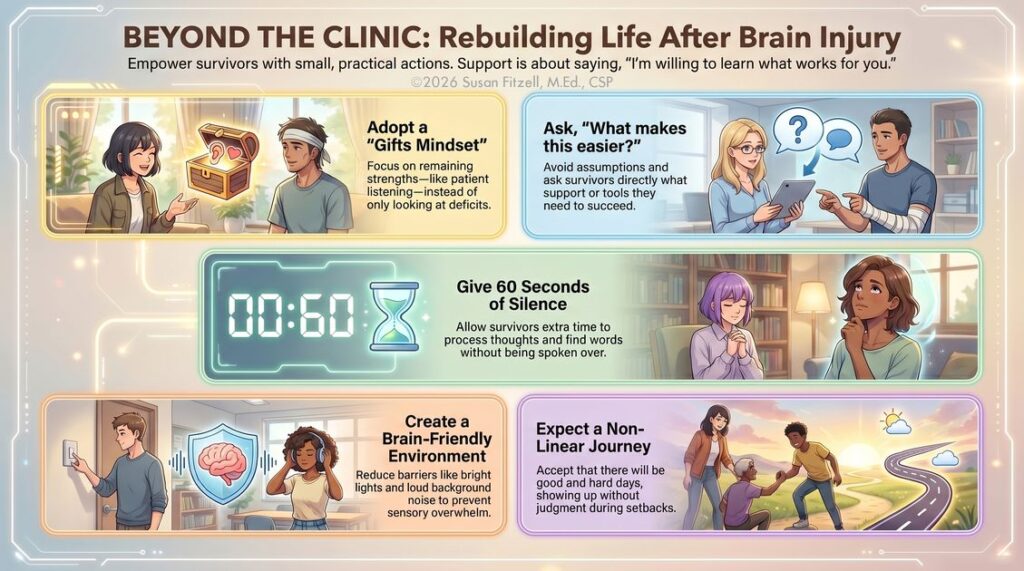
There is no perfect plan. There’s no ready-made list of best practices or one-size-fits-all solutions that you can check off and put away. What helps the most is small, consistent, respectful action. We need the kind of support that says, “I’m willing to learn what works for you, and I’m willing to adjust.”
Here are some practical places to start.
Recognize Strengths After Brain Injury

After a brain injury, it’s natural to focus on what’s harder now. That’s part of the picture, but it’s not the whole picture. People still have strengths. Sometimes those strengths show up in new ways.
I’ve seen people become more patient listeners because they understand, in a very personal way, what it feels like to need time. Name that strength: “I appreciate how well you listen to your colleagues, employees, or mentors.” Too often, we focus on deficits and overlook what a person does well. Recognizing those strengths helps confidence return a little at a time. I call this practice having a “Gifts Mindset.”
I learned the profound power of patient listening from a middle school student named Jimmy. He was struggling in his classes and acting out in frustration, so I asked him what he would do differently if he were the teacher. His answer left me gobsmacked: “I would draw pictures on the board.” He explained that he loved science but could not grasp the lessons without visuals. “Thanks for asking me what would help me,” he said. “I wish my teachers would do that.” When his teachers began using diagrams and pictures, his behavior improved dramatically. The lesson was simple. Ask people what they need, listen patiently, and respect their answer.
Ask What Support Would Make Things Easier
Avoid making assumptions. This is more difficult than it sounds because humans are wired to make quick judgments about their experiences. For example, a manager once publicly called out an engineer for wearing headphones during team meetings, assuming he was listening to music. In reality, the engineer was using them to block out background noise so he could actually hear the manager better.
Imagine the difference it would make if we just asked, “What would make this easier for you?” Then listen to the answer. They may need written directions, a sit-stand workstation, or a few extra minutes to respond. Small changes can make a big difference.
Rehabilitation professionals and counselors often help people identify the supports they will need before returning to work, school, or daily life. Being able to identify those supports and advocate for themselves is key to rebuilding confidence and independence.
Give People Time to Process and Find the Words
When words don’t come easily, conversation can become stressful very quickly. It’s tempting to jump in, finish a sentence, or try to move things along. Most of the time, that doesn’t help. For example, one of my colleagues described the intense effort required to process and participate in workplace conversations. She explained, “I have to mentally rehearse what I want to say. But even then, I’m spoken over, misinterpreted, or worse, ignored!”
Have you ever asked a question and then silently counted to sixty before expecting an answer? Sixty seconds can seem like a long, awkward eternity. Yet, that’s exactly what some people need to find the right words to express themselves. Even when it takes longer than expected, the wait may be well worth it. The goal isn’t speed. The goal is to communicate with dignity and allow a person’s brilliance to shine.
Reduce Environmental Barriers That Make Daily Life Harder
The environment matters more than most people realize.
A person may perform well in a quiet, structured rehabilitation setting and still struggle to sustain the same level of functioning in a noisy workplace, busy classroom, or unpredictable home environment.
Bright lights, crowded spaces, constant interruptions, background noise, and unpredictable schedules can turn a good day into a hard one.
Simple adjustments might help. Consider dimmer lighting to reduce visual strain or a quiet space to limit noise and interruptions before they become overwhelming.
Be proactive. Instead of waiting until someone is struggling to ask what they need, build that kind of check-in into the way you work with people.
It’s good for everyone. It’s critical for differently wired brains.
Expect Good Days and Hard Days During Recovery
Recovery and adjustment aren’t straight lines. There will be good days. There will be hard days. There will be progress, and there will be setbacks.
That’s real life.
What matters is how we show up for each other. We show up without judgment. We stay steady. We adjust when something isn’t working. We don’t take over when a little support is enough. We don’t disappear when things get difficult.
That kind of patience helps rebuild trust.
These ideas aren’t just for professionals or caregivers. Whether you’re a leader, counselor, employer, family member, or friend, you have more influence than you may realize in helping someone rebuild confidence, purpose, and a sense of belonging.
Rehabilitation professionals can also help families, employers, educators, and community members understand how to continue effective supports beyond formal treatment sessions.
These practical supports do not replace medical care or rehabilitation. They help people apply their strengths and rehabilitation strategies in the environments where daily life actually happens.
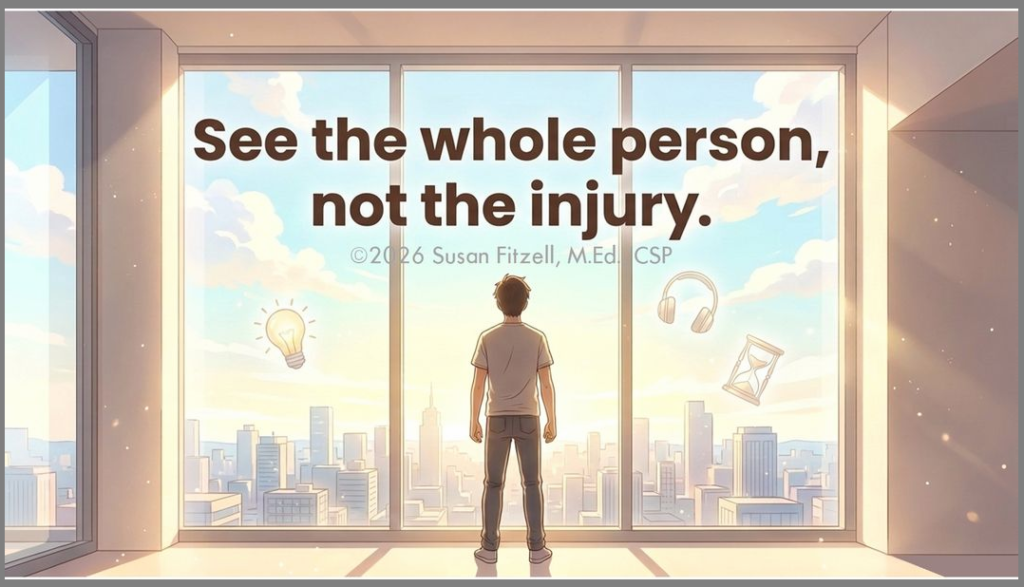
In the end, the most powerful thing we can do is see the whole person, not just the injury. After a brain injury, people may need new strategies, adjusted environments, and time to rebuild confidence. When we make daily life and work more brain-friendly, we help people reconnect with their strengths, their purpose, and their future.
By Susan Fitzell, M.Ed., CSP.
1194 words. Download the Word Document for your staff or publication.
If used online, attribution with a link back to the original article [ LINK HERE ] on my website is appreciated.
Suggested attribution:
Susan Fitzell, M.Ed., CSP, is a speaker, author, and consultant who helps organizations create brain-friendly workplaces where more people can succeed. Her latest book is “Neurodiversity in the Workplace: Maximizing Success through Inclusive Dynamic Workplace Design.”
FAQ
Adults recovering from a brain injury often benefit from practical support that recognizes both their challenges and their strengths. Helpful approaches include asking what they need, allowing additional processing time, reducing environmental distractions, and acknowledging what they continue to do well. Small, respectful adjustments can help rebuild confidence and independence.
Brain injury rehabilitation strategies are most effective when they extend beyond the clinic into workplaces, classrooms, homes, and community settings. Written instructions, quieter environments, flexible schedules, visual supports, and extra response time can help a person apply what they learned in rehabilitation to everyday responsibilities.
Employers can support return to work after brain injury by asking the employee what would make tasks more manageable rather than making assumptions. Depending on the person’s needs, support might include written directions, fewer interruptions, noise reduction, flexible scheduling, a quieter workspace, or additional time to process information.
A brain injury can affect processing speed, word retrieval, attention, and the ability to organize thoughts. A person may know what they want to say but need more time to find the words and express the idea. Waiting patiently instead of interrupting or finishing the person’s sentence supports dignity and more effective communication.
Rehabilitation professionals can help people identify the strategies and accommodations they may need when returning to work, school, or community life. They can also help individuals practice self-advocacy and explain effective supports to families, employers, and educators. This helps bridge the gap between formal rehabilitation and real-world participation.
 | CLICK HERE to learn how to Maximize Success in YOUR workplace!. Bring Susan to your organization!Featured seminar – Inspiring Success: Leadership Strategies that Promote Employee Success |