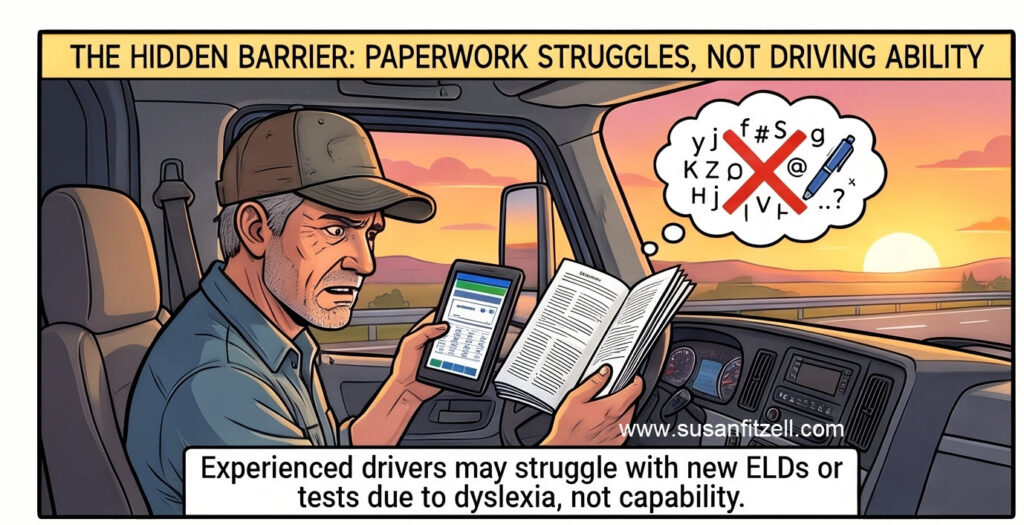
Imagine having a truck driver with 20 years of experience. This driver knows the truck. Knows the roads. Can back into tight loading docks, spot problems before they happen, and handle tough driving conditions.
You’ve got someone who has spent years building skills that keep people and cargo safe.
Then your company brings in a new electronic logging device (ELD). Or you require drivers to take an online test. Maybe you’ve changed the way they need to read and report safety information.
Suddenly, a driver who’s done the job well for years starts to struggle.
Not because they can’t drive. Not because they don’t know their job. And certainly not because they’re not smart.
It’s because they have dyslexia, and the way your company now gives them information makes their job harder than it needs to be.
We need to talk about this.
Dyslexia Has Nothing to Do with Being Smart
One of the biggest myths about dyslexia is that people who struggle with reading or writing aren’t as smart as others.
That’s simply not true.
Many people with dyslexia are great at seeing patterns, solving problems, and working with their hands. Some can picture how things fit together before they ever pick up a tool.
Of course, not everyone with dyslexia has the same strengths. We’re all different.
I’ve seen this in my own family.
My son, Ian, has severe dyslexia. When he was in high school, some teachers told us he wasn’t “honors material.”
Yet he had an amazing gift for seeing how things worked.
Today, he’s an award-winning mechanical engineer. He’s worked on race engines and hydrogen fuel technology.
Think about that.
What if we had listened to the people who told us what he couldn’t do? What if we had let his reading struggles decide his future?
Now think about a truck driver who can hear that something isn’t right with an engine. Or one who can back a big rig into a space that looks almost too small. Or a driver who can find the best way around a road closure without getting rattled.
Those skills matter.
We need to look at what people can do, not just what they struggle with.
When Paperwork Is Harder Than Driving
I have dyslexia myself.
I know what it’s like to look at a page full of words and feel tired before I’ve even finished reading it.
Sometimes I have to read the same thing over and over to make sure I understand it. When I’m tired or stressed, letters and numbers can seem to flip around on the screen.
It’s hard work.
Now imagine dealing with that after a full day of driving.
Truck drivers have a lot more to do than drive. They have to fill out forms, keep records, learn new rules, and use computer systems that aren’t always easy to understand.
ELDs can make some tasks easier. But they can also cause stress when screens are confusing, or steps aren’t clear.
Employers also need to understand something else.
Many adults with dyslexia have spent years hiding it.
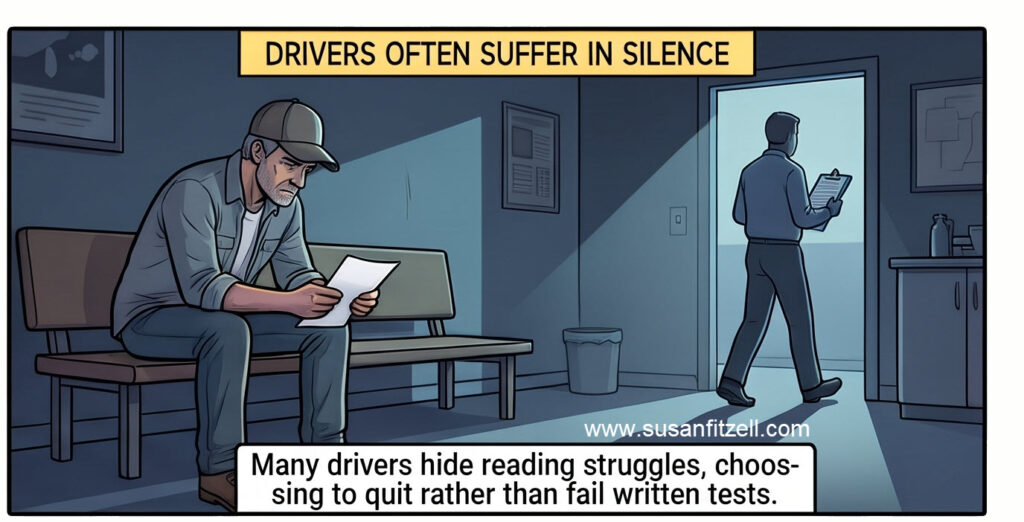
In school, they may have been called lazy or careless. Some were told they just weren’t trying hard enough.
So they found ways to get by. They learned tricks to do their jobs without anyone knowing they struggled with reading or writing.
Then the company changes the system.
The tools and tricks that worked for years may no longer help.
That’s when a good worker can begin to struggle.
A Great Employee Who Couldn’t Pass the Test
I worked with a sales rep I’ll call Ben.
Ben was very good at his job. He knew his products, cared about his customers, and had years of experience.
He also had dyslexia.
For years, Ben found ways to do his work well. Most people had no idea how hard some reading tasks were for him.
Then his company brought in a new online training system. It included long reading lessons and written tests.
Ben’s test scores didn’t reflect his understanding of the product.
Did he forget how to sell? Did he stop knowing his products? Did all his years of experience suddenly mean nothing?
Of course not!
The job hadn’t changed much. But the way the company tested him had.
Ben needed a different way to show what he knew. His company would not give him that option.
In the end, Ben left. The company lost a good worker and years of institutional wisdom.
What a waste!
The same thing can happen in the trucking industry.
A driver may have a great safety record. They may know their truck inside and out. They may have driven for years without a major problem.
Then they face a written test or online training course that doesn’t match the way they learn best.
I’m not saying drivers should get a pass on safety rules. Not at all.
They must know the rules and follow them.
But there’s a big difference between knowing how to do a job safely and passing a long written test.
When the rules allow it, why not give people another way to show what they know?
Technology Can Make a Big Difference
I’ve learned to use technology to help me do my own work.
I’m an author, speaker, and consultant. I write books, articles, and training programs.
But writing the usual way can be hard for me.
So I use speech-to-text software. I speak my ideas, and the computer puts my words on the screen.
In fact, I’ve used this kind of software to help write my books.
I know what I want to say. The software helps me get the words down.
That’s not cheating. It’s working smarter.
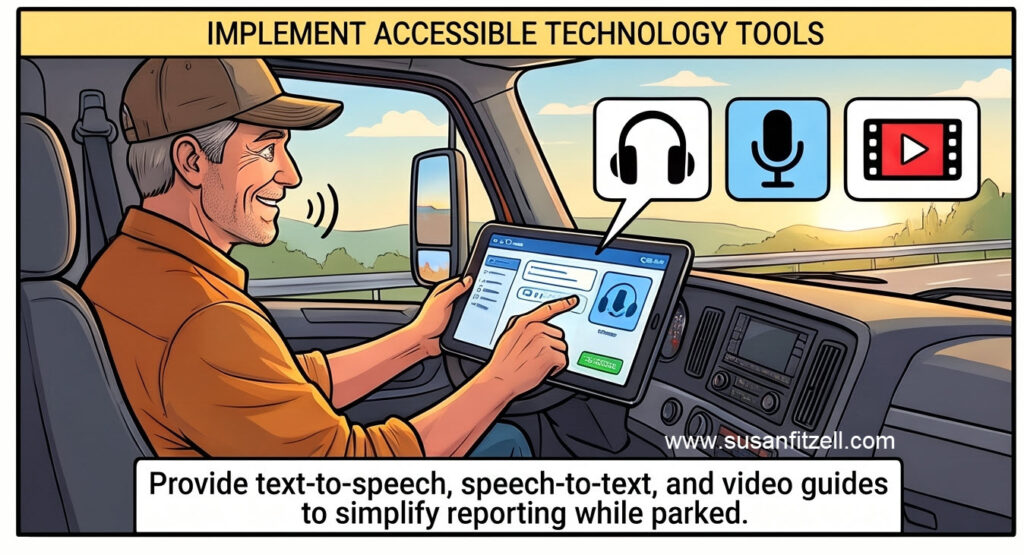
Drivers can use tools like these, too.
Text-to-speech: This tool reads words out loud. A driver could listen to new company rules while parked instead of trying to read pages of small print.
Speech-to-text: A driver could speak a report instead of typing every word. They would still need to check the report before sending it.
Visual guides: Pictures, charts, and short checklists can make long sets of steps easier to follow.
Video training: Watching someone show how to use a new ELD may work better than reading a thick manual.
These tools can help everyone, not just people with dyslexia.
Think about it. Wouldn’t most drivers rather watch a short, clear video than read 20 pages of instructions?
A mantra I’ve shared with audiences for years is that flexibility, or different modes of learning and testing, is “good for all but critical for people who learn differently.”
Why not make these tools easy for all workers to use?
Of course, drivers should only use reading and writing tools when it’s safe, such as when they’re parked. They must still check their records and follow all safety rules.
What Can Employers Do?
Companies spend a lot of money hiring and training drivers.
Why make it harder for good drivers to stay on the job?
Employers can help in simple ways.
1. Give workers more than one way to learn.
Don’t just hand out pages of rules. Add short videos, audio recordings, pictures, and clear checklists.
2. Make computer systems easier to use.
Can drivers make the words bigger? Can they listen to the words? Are the steps clear?
Ask the people who use the system every day what needs to change.
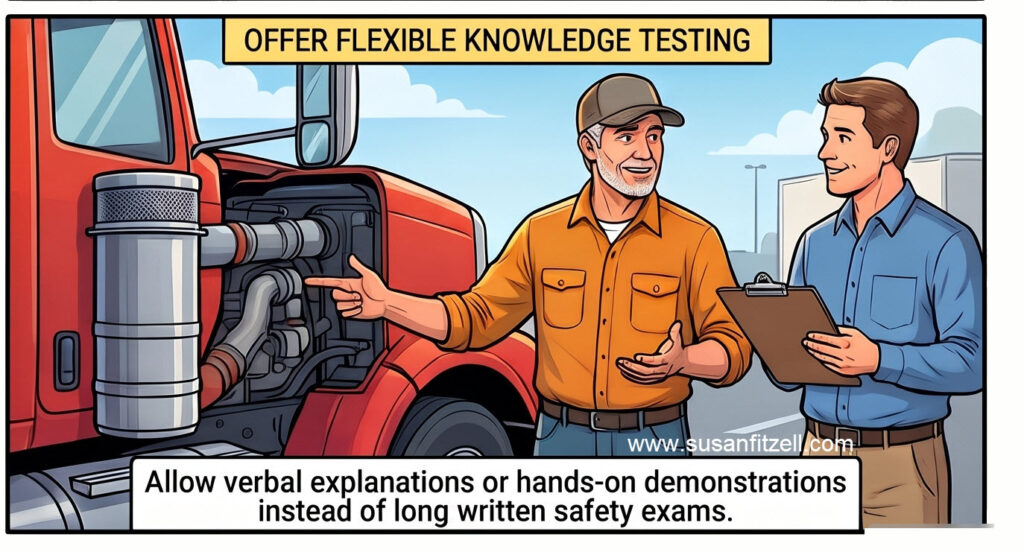
3. Let workers show what they know in different ways, when allowed.
Could a driver explain a safety rule out loud? Could they show how to do a safety check instead of only answering written questions?
Some tests must be given in a set way by law. Those rules still apply.
4. Help drivers learn new systems.
Show them how a new ELD works. Let them practice. Give them someone they can ask for help without feeling foolish.
5. Make help available to everyone.
This is a big one.
Many adults don’t want to tell their bosses they have dyslexia. They may worry that people will think less of them.
If you offer tools to everyone, workers can choose what helps without having to explain their private struggles.
Some workers may still need special help or a workplace accommodation. Those needs should be taken seriously.
What If You’re the Driver Who’s Struggling?
Maybe you’ve driven for years and know you’re good at your job.
But the paperwork keeps getting harder.
Maybe you put off filling out reports because reading and writing take so much time. Maybe you hate written tests, even when you know the answers.
That doesn’t always mean you have dyslexia. But if reading has been hard for you since you were young, it may be worth finding out why.
You don’t have to tell your boss your whole life story to ask for help.
You might say:
“I know my job, and I want to make sure I’m doing the paperwork right. This new computer system is hard for me to follow. Could someone show me the steps or give me a guide with pictures?”
That’s a fair request.
If reading and writing keep getting in the way of your work, you may want to learn more about dyslexia and the help that may be available.
The goal is to do your job well and safely. There may be a better way to handle the reading and paperwork.
Let’s Focus on What People CAN Do!
Over the years, I’ve worked with many smart, skilled people who struggled with reading and writing.
I’ve also seen what happens when we focus so much on what someone can’t do that we miss all the things they do well.
We lose good people that way.
Think about the driver who has traveled a million miles safely. Or the mechanic who can find a problem no one else can. Or the worker who can handle a tough job because they’ve learned from years of hands-on experience.
Those skills have real value.
Yes, drivers must follow safety rules. Yes, records must be right. And yes, everyone must meet the same safety standards.
But we also need to ask a simple question.
Are we giving people the tools they need to do their best work?
Sometimes all it takes is a short video, a clear picture, a tool that reads words out loud, or someone willing to show how something works.
For a worker with dyslexia, that kind of help can make all the difference.
For an employer, it can mean keeping a great driver instead of losing someone with years of skill and experience.
Companies can’t afford to lose good drivers simply because the paperwork has become harder than the job itself.
And that’s a whole lot better than losing a good driver over paperwork.
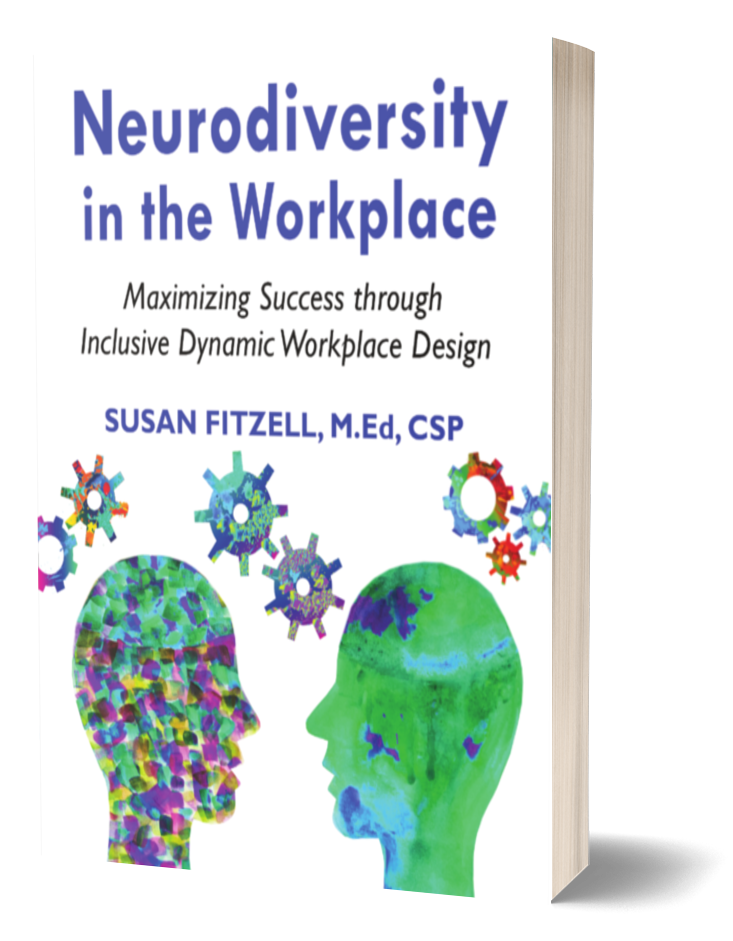 | CLICK HERE to learn how to Maximize Success in YOUR workplace!. Bring Susan to your organization!Featured seminar – Inspiring Success: Leadership Strategies that Promote Employee Success |