
Why Neurodiversity in the Workplace Matters
Many leaders say they value diversity, but they often overlook one of the most important forms of difference on a team – neurodiversity. When organizations build workplaces that welcome different ways of thinking, processing information, communicating, and solving problems, they gain more than inclusion. They gain creativity, innovation, and stronger problem-solving across the board.
The challenge is that many traditional hiring and workplace practices were designed around neurotypical norms. If you want neurodivergent employees to thrive, you need to rethink both how you hire and how you support people once they join the team.
I recently spoke with Gregg Gregory on his podcast The Teamwork Advantage about the importance of neurodiverse teams and how to nurture them.
So, what can businesses and managers do to hire more neurodivergent people and create a workplace that allows them to thrive?
How Hiring Practices Can Exclude Neurodivergent Talent
Many traditional hiring practices do not accommodate people with neurodivergence, or only accommodate those who have learned to mask their neurodivergence. Masking is the ability to act like a neurotypical person in social settings. This behavior is often learned while young to fit in with peers.
Traditional hiring practices are tailored to people with neurotypical brains. They require a good grasp of social norms to succeed. In-person interviews, for example, require a lot of eye contact and positive body language. It also requires the interviewee to read between the lines and address the subtext of a question along with the actual question. These practices would rule out some candidates with Attention Deficit Disorder with Hyperactivity (ADHD) or autism, regardless of how capable they are for the actual role.
The practice of asking for a resume or cover letter may also eliminate neurodivergent people. It is an obvious barrier for people with dyslexia, but other neurodivergent groups may also struggle to know what to write. Unless they get professional help to write these documents, they may not even make it through the process to get an interview.
Currently, more companies in sectors like technology and finance are recognizing that neurodivergent employees bring valuable strengths to the workplace, including pattern recognition, innovation, focus, persistence, and unconventional problem-solving.
Companies that are looking to hire neurodivergent employees haven’t dropped traditional hiring practices, but they have added processes that allow them to better assess the suitability of candidates. In many cases, they ask candidates to complete mini-projects or solve problems to see their abilities. This is a win-win situation for companies because they are hiring people who can do the job, not just people who fit the neurotypical mold.
How to Build a Neuroinclusive Workplace Culture
Hiring a neurodiverse team is only part of the process. Companies also need to create an atmosphere where neurodivergent people feel safe and comfortable. Without this, your neurodivergent team members will not thrive, or worse, they may face hostility from colleagues or managers.
I like to look at the pandemic as an example of what happens when companies accommodate the needs of their employees. Before the pandemic, corporate culture was adamant that employees needed to be in the office to achieve peak productivity and collaboration. It was thought that allowing employees to work from home would cost too much in terms of productivity, system management, and company culture.
But when the world was forced to work from home, we discovered that wasn’t the case. Companies that loosened the reins and were open to different ways of working thrived during the pandemic. So, for companies who wonder how best to support neurodivergent workers, the answer is, the same way you supported workers during the pandemic. Let your team tell you how they work best, be open to trying different things.
It is not just people with autism, ADHD, or sensory processing disorders who will benefit. Taking a flexible approach to the workplace will benefit all your employees. It will help people with different learning preferences, different social capacities, and even those experiencing stress to have a better workplace experience. Discussions around working styles and needs will help your team become more sensitive to each other’s needs.
A great example of this is Ultranauts Inc., a software testing company that employs many autistic people. All new hires are given a BioDex, A user manual for every teammate, that introduces them to their new team members. Included in the BioDex is data about preferred working styles and communication methods to ensure a harmonious work environment.
This kind of initiative not only helps neurodivergent team members, but neurotypical team members also benefit from people communicating with them in their preferred manner.
An employee user’s manual is a great step in promoting the cultural change that is necessary to successfully create a neurodiverse team. It provides opportunities for people to consider their work preferences and understand that others may have different inclinations. So, when someone with a sensory disorder needs to wear earbuds or headphones at work to concentrate, it is less likely to cause offense to other team members. It also opens the door for neurotypical employees to be able to use noise-canceling headphones when they need to concentrate; open-plan offices aren’t conducive to deep focus.
Simple Workplace Accommodations That Help Everyone
Being open to creating a workplace that is conducive to the needs of neurodivergent employees means understanding that people work best in different ways. While it’s important to have conversations about how to make workplaces more inclusive to neurodivergent people, these conversations are futile when C-Suite executives promote a “one size fits all” approach to workplaces. Even neurotypical people don’t all work in the same way. Extroverts may thrive in open-plan offices, while introverts would prefer more privacy. Visual learners may struggle in verbal brainstorming meetings, while auditory learners may thrive.
By empowering employees to discuss their individual needs, businesses can create a workplace where workers can reach their full potential. Think about it; an introvert is never going to be able to do their best work in an open-plan office when people keep stopping by their desk to “pick their brain.” But if they had the ability to tailor their work environment to their needs, they could improve their output. It doesn’t require renovations or expensive tools. An introverted employee could discuss working from home when they need to or wearing headphones in the office when they need more focus. They could discuss their communication preferences with colleagues and ask them to email instead of stopping by.
Yes, these culture shifts make the workplace accessible to neurodivergent people, but they also result in an overall happier, more productive workforce. Cultivating a neurodiverse team should not be viewed as disruptive or too much work; it is a win for everyone involved.
FAQ
What is neurodiversity in the workplace?
Neurodiversity in the workplace refers to the presence of employees who think, learn, process information, and communicate in different ways. A neurodiverse workforce includes both neurotypical and neurodivergent individuals. When organizations recognize and support those differences, they create stronger, more innovative teams.
What does it mean to build a neuroinclusive workplace?
A neuroinclusive workplace is a work environment designed to support different thinking styles, communication preferences, sensory needs, and problem-solving approaches. This can include flexible communication methods, alternative hiring practices, sensory-friendly options, and clear expectations that help all employees do their best work.
How can hiring practices be more inclusive for neurodivergent candidates?
Hiring practices become more inclusive when we reduce unnecessary reliance on resumes, cover letters, eye contact, social performance, and vague interview questions. Employers can use work samples, problem-solving tasks, job previews, and clearer communication to assess whether a candidate can do the job rather than whether they fit a narrow social mold.
What workplace accommodations help neurodivergent employees thrive?
Helpful accommodations may include flexible work location, quiet spaces, headphones, written follow-up after meetings, clear deadlines, predictable routines, visual supports, and communication preferences that reduce ambiguity. Many of these supports help all employees, not only neurodivergent team members.
Why does neurodiversity benefit workplace teams?
Neurodiversity benefits teams because people who think differently often bring unique strengths in creativity, pattern recognition, problem-solving, innovation, attention to detail, and systems thinking. A team that includes different cognitive styles is often better equipped to identify inefficiencies and generate fresh solutions.
Neurodiversity, Neurodivergent, and Neurodiverse: What the Terms Mean
Neurodiversity: this term refers to a general diversity of minds. It includes people who are neurotypical and neurodivergent. When I talk about promoting neurodiversity in the workplace, for example, I am referring to creating a diverse workforce representative of the broad spectrum that exists when it comes to ways of thinking, processing information, communication, and learning. Some employees may be “normal” or neurotypical while others may have ADHD, Dyslexia, Autism, or trauma impacted ways of thinking. I am not referring to any particular label or diagnosis, but rather, the concept of an environment where a diversity of minds coexist.
Neurodiverse: This word is pretty much the same as neurodiversity, but should be used as an adjective. You can say, for example, that your workplace is neurodiverse.
Be careful though, because you should never describe a person as being neurodiverse. Individual people should be described as neurodivergent.
Neurodivergent: This word describes an individual whose way of thinking falls outside of society’s defined version of normal, or neurotypical. Oftentimes you will see it abbreviated as ND.
Many times, neurodivergent people will have a diagnosis or label you may recognize, like autism, dyslexia, or ADHD. But neurodivergent people are also those with epilepsy, different kinds of brain trauma, or simply a unique way of thinking that may not have a specific diagnosis.
 FREE DOWNLOAD: Neurodiversity in the Workplace: Things to Consider Before You Jump On the Bandwagon
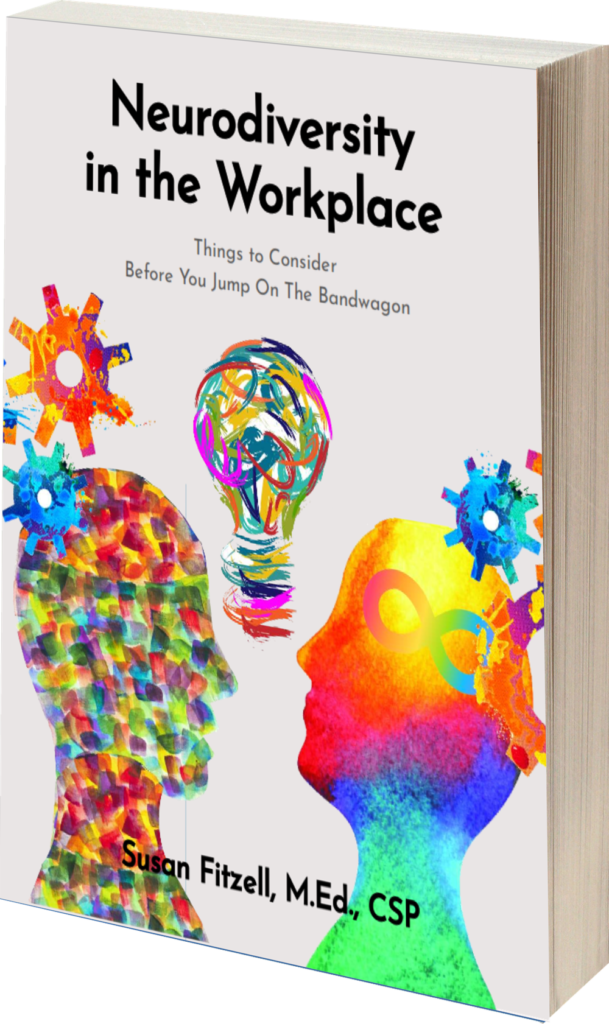
Neurodiverse hiring practices can benefit any company in any industry and in more areas than most people realize. The investment has yielded greater patenting, innovation, process improvement, efficiency, and creativity not only in technology industries but also in industries that include investment banking, insurance, and mortgage banking.
This resource explains the term “neurodiversity” and describes the potential positive impact on your business that can come from including neurodivergent individuals in your workplace.
Download Neurodiversity in the Workplace! – Free!
Bring Susan Fitzell, M.Ed., CSP
Top Neurodiversity Speaker
To YOUR Organization!