The Big Shift in Learning
Have you ever taken a course and did everything you were told to do and yet still didn’t get it? It is not because you can’t learn.
Traditional instruction has relied on a “talk and test” model:
Say it. Assign it. Test it.
This approach works for some learners, but it fails many others.
When instruction is delivered in only one format, it does not measure true learning. It measures how well someone can comply with that specific teaching method.
Real learning happens when there are multiple ways to access and process information.
The first step toward becoming a more effective learner is understanding your learning strengths and information processing style.
Learning Styles vs. Reality: How People Actually Learn
Traditional Model:
- One path for everyone
- Measures compliance
- Leaves many learners behind
Effective Learning Model:
- Multiple access points
- Based on individual strengths
- Measures true understanding
- Reaches nearly all learners
Common Learning Styles and Strategies
These are not labels meant to box you in. They are tools to help you find your own way into a subject. You have permission to learn differently.
- Word Learners. These people like reading, writing, and storytelling. They remember what they hear or read.
Strategy: If you learn this way, do not just stare at a page. Take control by writing a script or an article to explain the concept.
- Pattern and System Thinkers. They ask “how does this work” a lot. They need a problem to solve or a strategy to build. They notice problem solving through cause and effect.
Strategy: Use logic to your advantage. If a lesson feels random, find the system or the code behind it.
- Movers and Doers. These people are hands on. They might fidget, tap, or shift while thinking. That is not a behavior problem. It is a clue. They show understanding through action.
Strategy: You are allowed to move to focus. Build a model or act it out to make the lesson stick.
- Visual Thinkers. You explain it and they get nothing. You draw it and boom. They might doodle while you speak, but they are still with you. They are visualizing the concept.
Strategy: Use diagrams, maps, and color. It is your way in.
- Sound and Rhythm Connectors. They pick up patterns in sound. They may hum, tap, or create beats while working. They use rhythm to store information.
Strategy: Use audio or verbal repetition to master hard facts.
- Social Processors. They learn by talking and collaborating. If you make them sit silently, they do not learn as well.
Strategy: You need interaction to think. Find a partner and talk the idea out to prove you get it.
- Independent Processors. They are reflecting on learning before they speak. They need quiet time to make deep sense of things.
Strategy: Your need for quiet is a strength. Take the time you need to process before you respond.
- Real-World Thinkers. They ask “When am I ever going to use this?” It is a fair question. They like sorting and notice details others miss.
Strategy: Connect the lesson to your environment. If the work is practical, you will master it faster.
- Big Picture Thinkers. They want meaning and purpose. They ask deep “why” questions. If they do not see a point, they are done.
The So What: Always look for the purpose first. Once you see the “why,” your focus will follow.
How to Identify Your Learning Strengths
Once you know how you learn, you can choose better ways to work. That is how you build independence. Use this checklist to find your top two or three strengths.
Questions to Ask Yourself
- [ ] Do I understand an idea faster when someone draws a map or diagram? (Visual)
- [ ] Do I find myself fidgeting or tapping when I am trying to focus? (Mover)
- [ ] Would I rather talk an idea through with a friend than write it down? (Social)
- [ ] Do I frequently ask why we are learning a specific topic or what it matters? (Big Picture)
- [ ] Do I need a few minutes of silence before I feel ready to answer a question? (Independent)
- [ ] Do I like to take things apart or build models to see how they work? (Pattern/Mover)
- [ ] Do I notice details in the environment that others seem to miss? (Real-World)
Learning Strategies That Match Your Strengths
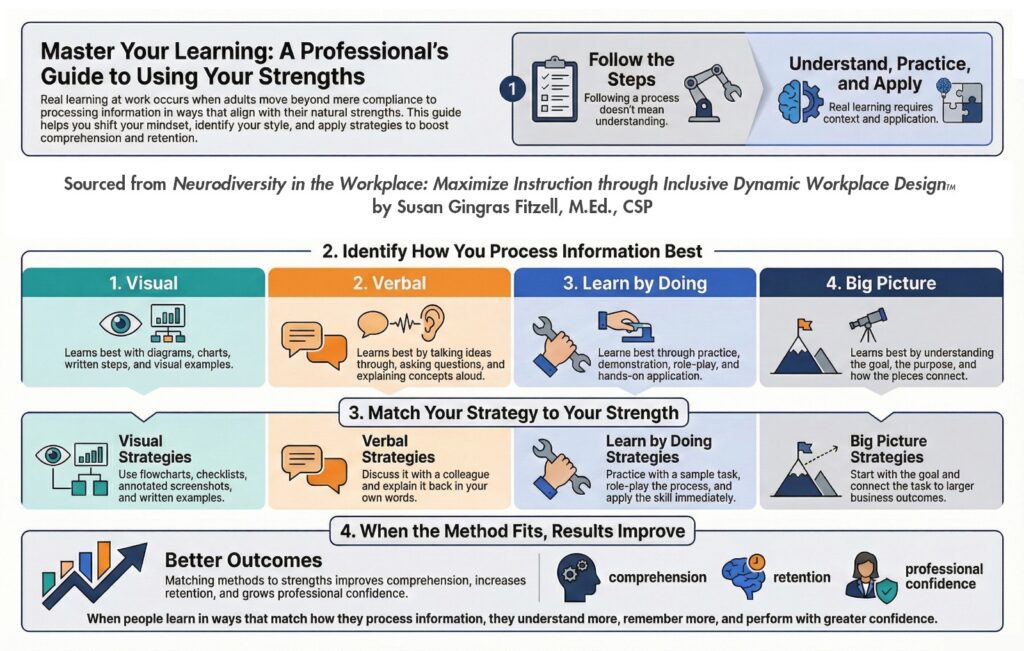
Effective learning happens when your strategy matches your processing style.
To process information:
- Visual → diagrams and mapping
- Auditory → repetition and discussion
- Logical → cause-and-effect analysis
- Practical → sorting and real-world application
To demonstrate learning:
- Verbal → writing or explaining
- Kinesthetic → building or demonstrating
- Independent → journaling
- Logical → designing systems or timelines
To stay engaged:
- Social → collaboration
- Big Picture → connect to purpose
- Kinesthetic → movement
- Independent → solo work before sharing
Final Thought: Start Small and Build Momentum
You do not need to change everything at once.
Start with one adjustment. One new strategy. One new way to access information.
When learning aligns with how your brain processes information, your confidence increases and your results improve.
Once you experience that shift, you will not go back.
Frequently Asked Questions About Learning Styles
What are learning strengths or learning styles?
Learning strengths refer to the ways individuals most effectively process and understand information, such as visual, auditory, kinesthetic, or verbal learning styles.
How can I identify how I learn best?
You can identify your learning style by noticing how you naturally process information – whether through visuals, discussion, movement, reflection, or real-world application.
Do learning styles actually improve learning outcomes?
Yes. When learning strategies align with how a person processes information, comprehension improves, retention increases, and engagement becomes more consistent.
 | CLICK HERE to learn how to Maximize Success in YOUR workplace!. Bring Susan to your organization! |