When my son Ian was three, he was doing puzzles designed for eight-year-olds. He was that kid who took apart old appliances just to see how they worked. His mind was curious, wired for exploration and innovation. But in school? He was behind in reading. Teachers misread his difficulty as distraction. One teacher even told him he “wasn’t honors-level material.”
Today, Ian is an award-winning mechanical engineer working on cutting-edge hydrogen fuel technology. He’s been recruited by top automotive firms to push the boundaries of sustainable design.
Here’s what I need you to know: Ian didn’t succeed because the system finally saw his strengths. He succeeded because he had support, advocacy, and someone—me—who knew how to fight for him.
Not every neurodivergent child or adult has that. And that’s the quiet danger in how we talk about neurodiversity.
As someone who’s lived with dyslexia, ADHD, and central auditory processing disorder—and spent decades helping organizations build more inclusive cultures—I am a fierce believer in a gifts-mindset. I’ve seen firsthand how focusing on strengths can change lives. But we have to be careful not to romanticize success stories like Ian’s as the norm. Because without systemic change, they won’t be.
Strengths don’t erase struggle. And no one should have to outperform their barriers to be seen as worthy.
When companies focus solely on “high-performing neurodivergent talent,” they risk reinforcing the very structures that keep so many brilliant minds from ever being recognized. I’ve worked with individuals who are creative problem-solvers, deep thinkers, and innovative leaders—but they’re exhausted, overlooked, or forced to mask in environments that don’t value their needs.
That’s why I developed the Inclusive Dynamic Workplace Design™ framework. It’s not about perks or productivity hacks. It’s about rethinking how we structure work to support all brains—not just the ones that can push through discomfort to deliver results.
Because even the most gifted seed won’t grow in toxic ground.
If we truly want to harness the power of neurodiversity, we must do more than celebrate potential—we must create spaces where potential can breathe.
FAQ
Why isn’t focusing on neurodivergent strengths enough?
Recognizing neurodivergent strengths is important, but strengths alone cannot overcome an inaccessible or unsupportive environment. Employees may bring creativity, problem-solving ability, deep expertise, or innovative thinking and still struggle if workplace systems create unnecessary barriers. A strengths-based approach works best when organizations also address culture, communication, flexibility, psychological safety, and workplace design.
How can employers help neurodivergent employees use their strengths at work?
Employers can help neurodivergent employees thrive by creating environments that support different ways of thinking, communicating, learning, and working. This can include flexible work practices, clear expectations, accessible communication, sensory considerations, supportive management, and opportunities for employees to use their strongest abilities rather than continually compensating for workplace barriers.
What is Inclusive Dynamic Workplace Design™?
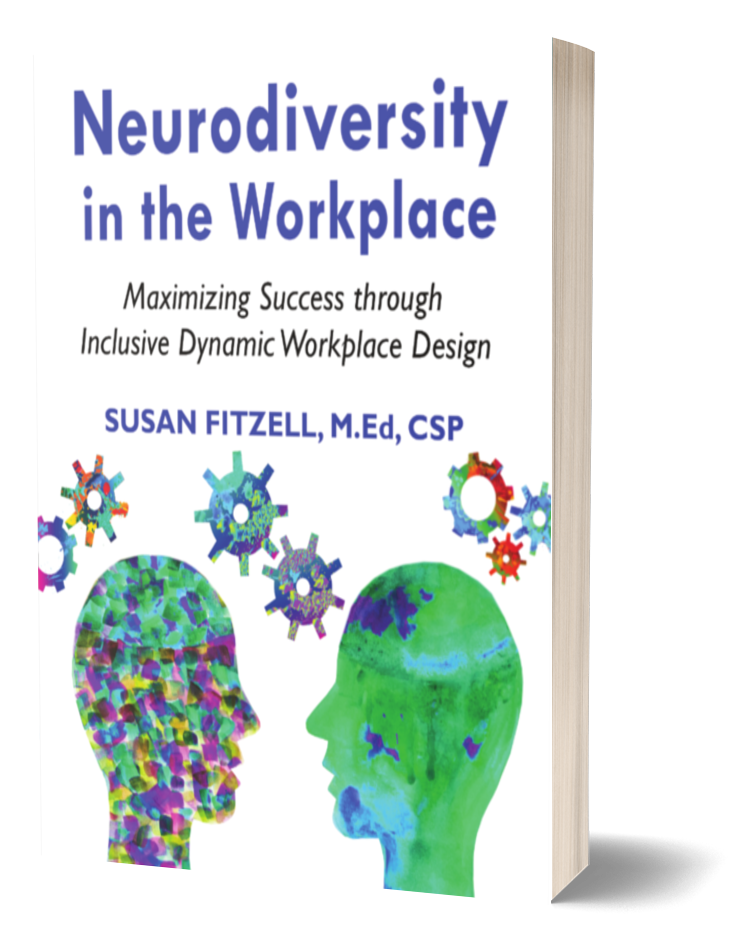
Inclusive Dynamic Workplace Design™ is Susan Fitzell’s framework for creating workplace systems and environments that support a wider range of employees. Rather than expecting neurodivergent employees to push through barriers or mask their differences, the approach examines how workplace culture, communication, physical space, learning, management practices, and flexibility can help people perform at their best.
 | CLICK HERE to learn how to Maximize Success in YOUR workplace!. Bring Susan to your organization! |