The Shift: Why One Way is No Longer Enough
Classroom accessibility in the general education classroom requires more than differentiation. It requires structured choice. This approach helps teachers reach diverse learning styles and improve student engagement without changing the core standard.
The “Talk-and-Test” era was simple. Say it. Assign it. Test it. This method assumes every student processes information the same way. We know that isn’t true.
If I teach one way, I get the kids whose learning preferences match that way.
If I teach a concept in multiple ways: I get almost everyone. That is the goal.
When we rely on one method of teaching and testing, we measure compliance. We do not measure learning. We are just seeing who can handle our specific style of teaching. If we want to reach every student, we have to change how they get to the content.
NOTE: I understand that some educators reading this just balked at what I wrote with these thoughts, “But, my [fill in the blank – principal, department head, supervisor, etc.] says that I have to follow the script in the teachers manual provided by the X,Y, Z publisher.
Please read the rest with a problem solving mindset. Can you incorporate any of these ideas into your teaching and still maintain the fidelity of the lesson plan you are required to teach.
The Instructional Shift
Traditional One-Way Instruction
- Focuses on “say it, assign it, test it.”
- Measures how well a student follows a method.
- Works for some students but leaves most behind.
- Relies heavily on talk-and-text delivery.
Multi-Modal Access
- Provides multiple ways to access the same idea.
- Measures the student’s actual understanding.
- Accelerates learning for almost every student.
- Varies how students interact with the work.
This shift starts with the students in the room. You have to look at the students sitting in front of you in your classroom(s).
Identifying Learning Strengths: The Nine Student Learning Preferences
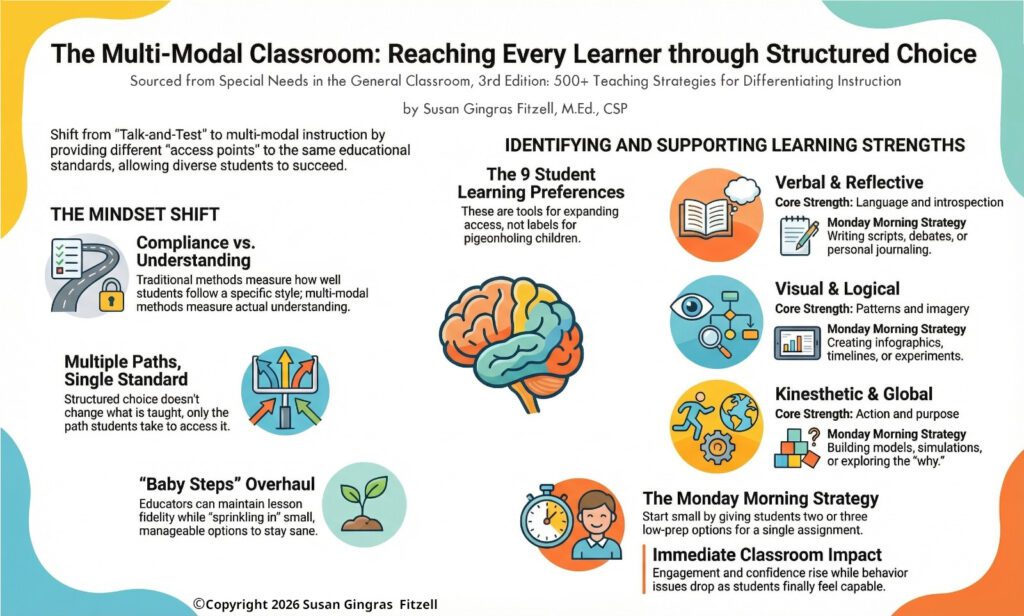
Every student has a way of working that feels natural to them. These preferences are tools for expansion. They are not labels for pigeonholing children. When you recognize these clues, you open the door to the work necessary to reach all learners.
- The Word Kids (Verbal Learners): They tell stories and explain ideas. Their strength is remembering what they hear or read.
- The System Thinkers (Logical Learners): They ask how it works and hate pointless worksheets. Their strength is finding patterns and solving problems.
- The Movers (Kinesthetic Learners): They fidget and tap to stay focused. Their strength is showing what they know through action.
- The Visual Learners: They doodle to stay with you. Their strength is understanding a drawing faster than a page of text.
- The Rhythm Learners: They hum or tap while they work. Their strength is remembering through patterns in sound.
- The Talkers (Collaborative Learners): They need to say it out loud to understand it. Their strength is collaborating and leading others.
- The Quiet Processors: They prefer to think first and talk later. Their strength is being reflective and self-aware.
- The Detail Seekers: They notice things others miss. Their strength is connecting lessons to practical, real-world systems.
- The Big Picture Thinkers: They disengage if the work feels pointless. Their strength is connecting learning to a larger purpose.
These learning preferences help us see that students are not being difficult. They are just trying to process what we are teaching. When they can’t, that’s often when we lose them.
From Chaos to Structured Choice
Many teachers worry that giving options leads to chaos. It doesn’t. Structured choice is not the same as having no plan.
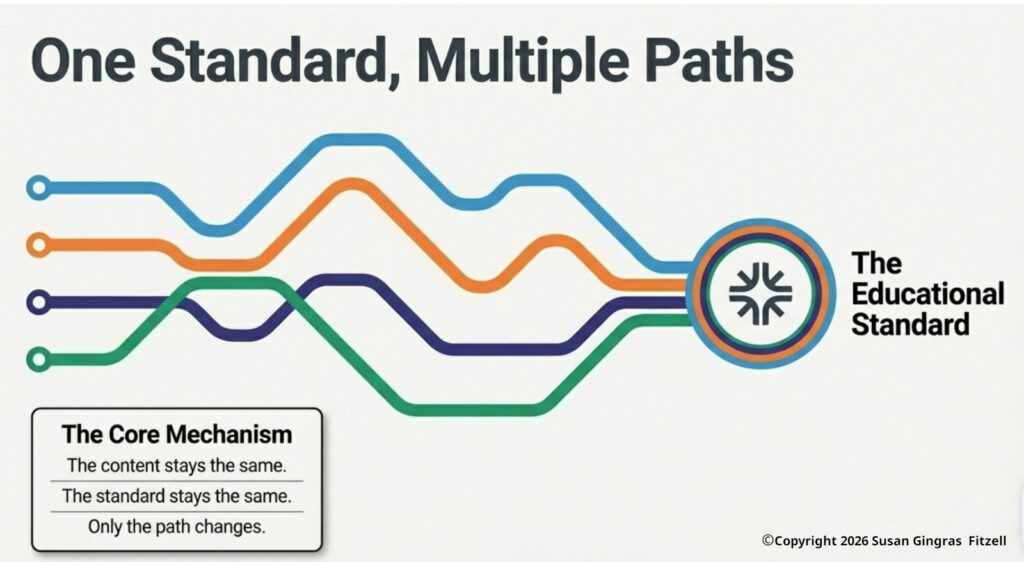
You do not need to create 27 different lesson plans. That is impossible. You only need to adjust student access to the same educational standard.
When we open up options, we stop fighting the students. We start helping them do the work.
Instead of asking, “Which students can handle my lesson?” ask, “How many ways can students access this idea?” Next, ask yourself, ‘How many of these ways can I sprinkle into my lesson plan and stay sane.’ I realize teachers often have ridiculous demands on their time and these ‘options’ may seem overwhelming. Take baby steps to incorporate different learning preferences into a lesson plan. Once those first steps become part of your teaching repertoire, then try others.
Theory is fine. But teachers need to know what to do when the bell rings on Monday.
The Monday Morning Strategy Guide
You do not have to overhaul your entire curriculum at once. Start small. Give students two or three options for an assignment. Use these low-prep strategies to get started.
- For Word Kids: Let them write a script or an article. They can teach a peer or create debate questions.
- For System Thinkers: Have them build a timeline or design an experiment. They can compare and contrast two ideas.
- For Movers: Let them act it out or build a model. They can use a simulation or create a physical demonstration.
- For Visual Thinkers: Ask them to draw it. They can make a map or an infographic. Use color to organize notes.
- For Rhythm Learners: Let them create a chant or a rhythmic explanation. They can explain the learning out loud to themselves.
- For Quiet Processors: Give them time to think first. Let them journal or write personal connections before they have to share.
- For Talkers: Use a turn and talk. Let them teach a friend or participate in a group debate.
- For Detail Seekers: Ask them to apply the lesson to a real-life situation. Let them sort or categorize information into systems.
- For Big Picture Thinkers: Let them explore the “why” behind the lesson. Connect the topic to a larger goal or a real-world value.
The content stays the same. The standard stays the same. Only the path changes.
This is the foundation of structured choice and differentiated instruction in today’s classroom.
The Impact: Measuring What Matters
When you use structured choice, the classroom changes. You stop measuring who can sit still. You start measuring who understands the material.
The results are immediate:
- Engagement goes up because students feel capable.
- Behavior issues go down because students aren’t frustrated.
- Confidence grows because students have a way to succeed.
The goal is for a student to say: “I get it.”
When a student finally accesses the content in a way that works, the shift is instant.
Once you see that happen, you don’t go back.
Frequently Asked Questions About Structured Choice in the Classroom
What is structured choice in the classroom?
Structured choice is an instructional strategy that gives students multiple ways to access and demonstrate learning while maintaining the same academic standard and learning objective.
How is structured choice different from differentiated instruction?
Structured choice is a practical application of differentiated instruction. It focuses specifically on offering students options in how they engage with content, process information, and demonstrate understanding.Does giving students choices create classroom management issues?
No. When implemented correctly, structured choice improves classroom management by increasing engagement, reducing frustration, and giving students clear, purposeful ways to participate in learning.
 | CLICK HERE to discover a wealth of teaching strategies and resources for maximizing student success!. Bring Susan to your campus!Featured seminar – Differentiation Strategies to Reach ALL Learners in the Inclusive Classroom |