Teachers, I see you.
Classrooms today are not easy to manage. Many students are coming to school with greater needs: inattention, low frustration tolerance, and weak social skills. They seem to be worse than what teachers were seeing a few years ago. Unfortunately, these issues often result in misbehavior.
When students are distracted, impulsive, or quick to push back, traditional classroom management is often not enough. That doesn’t mean you are doing anything wrong. It means we need practical, proactive systems that reduce power struggles, increase structure, and help students function more successfully at school.
This article offers strategies you can use to support behavior, strengthen focus, and make the classroom feel more workable again.
Setting the Stage for Success
Each of us has our own preference for class structure, consistency, and management. I believe it is important to understand that we need to be free to be ourselves and have our own styles of running our classrooms. Yet, some teaching styles seem to lend themselves well to today’s inclusive populations, where others are more challenging for both students and teachers.
Consider these approaches for a successful classroom environment:
• Consistency without rigidity
• Firm discipline without power struggles
• Reasonable flexibility without lax standards
• The goal of the lesson rather than the specifics of the process
• Learning as the goal, rather than focusing on just that test grade
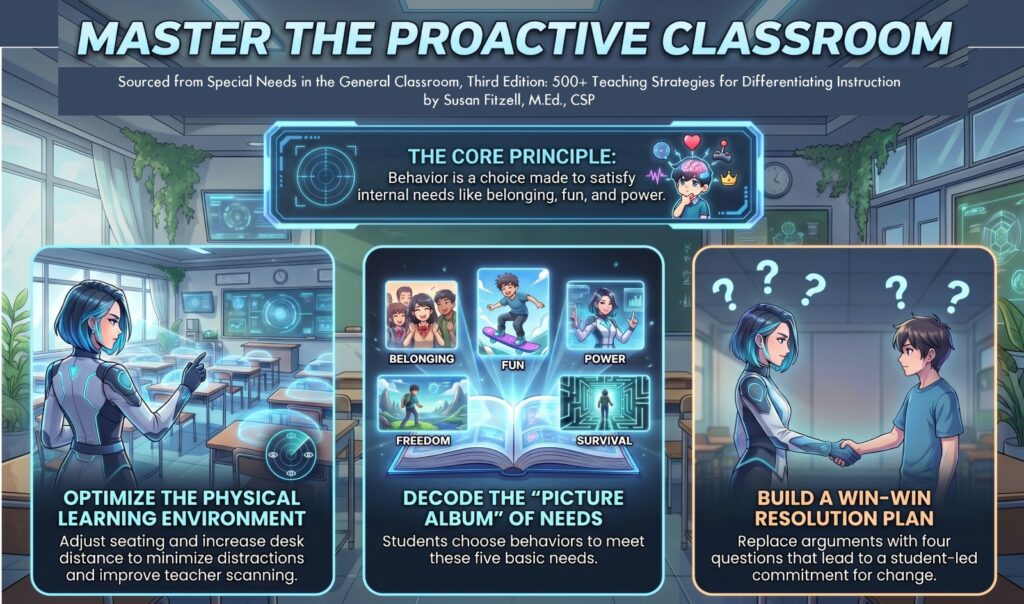
Physical Structure and Environmental Variables
Before we address behavior directly, I always suggest looking at the physical environment.
Consider Classroom Seating Options
Can we change student seating? I try to move students who struggle to self-regulate closer to the center of instruction, closer to me, or away from distractions. Consider allowing a student to choose a new seat as part of a win-win behavior plan. This ensures the student owns the behavior and the solution.
The Personal Office Solution
I’ve also found DIY study carrels to be valuable.
I first saw them in use in a fifth grade classroom. I wasn’t sure they would be well received when I introduced them to my high school students, yet some of the students loved them. They provide a space free of distractions as well as a secure personal space. I did not force these on students. It was an option I provided.
For example, I might say, “You can choose a different seat as well as a ‘personal office’ or you can choose to stay where you are sitting. However, that seat does not appear to be working for you. Make a good choice for yourself.”
The Spacing Solution
Increase the distance between desks and provide more space if possible. Scan the room frequently and stay alert to what students are engaged in at all times. Okay, I know you don’t have eyes in the back of your head and there are times when you can’t see everything. Try to stay with me. You may find these ideas are worth considering. Some of the classrooms I’ve observed in the past few years are crowded. I’m empathetic to the challenge educators face when they are trying to teach thirty students all at once, often in a multi-ability classroom.
The Grouping Solution – Mixed Ability Groups with Role Models
Finally, we should avoid seating students who struggle academically together as a permanent seating arrangement. It singles them out for stigmatization and creates a situation where they may feed off each other behaviorally.
The Technique that Changed My Teacher Life: Proactive Behavior Plans
I have found this approach to be highly effective with adolescents. It is based on a proactive choice model, and the goal is to teach young people how to take control of their own lives, make more effective choices, and develop the strength to handle daily problems.
At its foundation is the belief that all humans choose behaviors in an attempt to fulfill basic needs like belonging, freedom, fun, power, and survival. Because human behavior is internally motivated, the only person’s behavior we can control is our own. Each of us fulfills these needs differently.
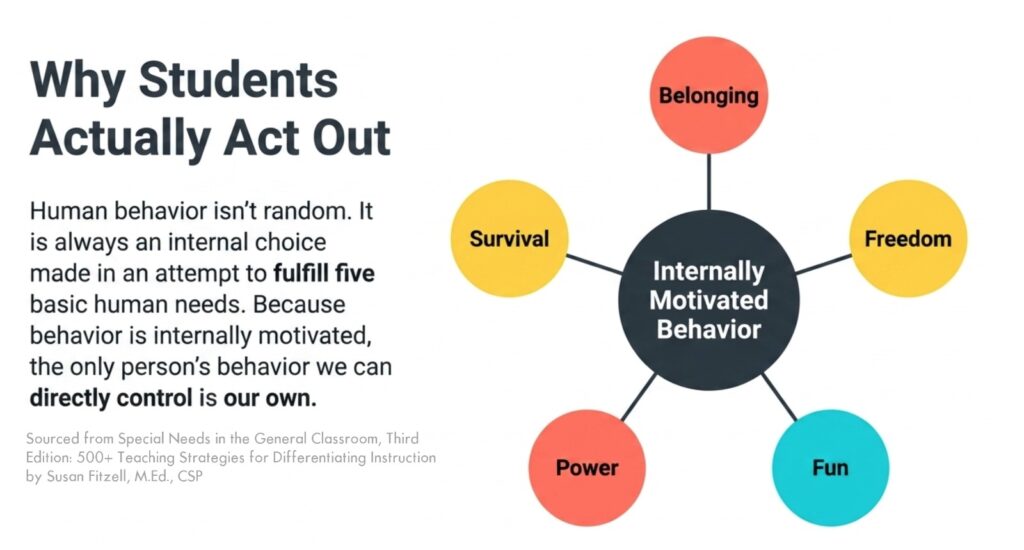
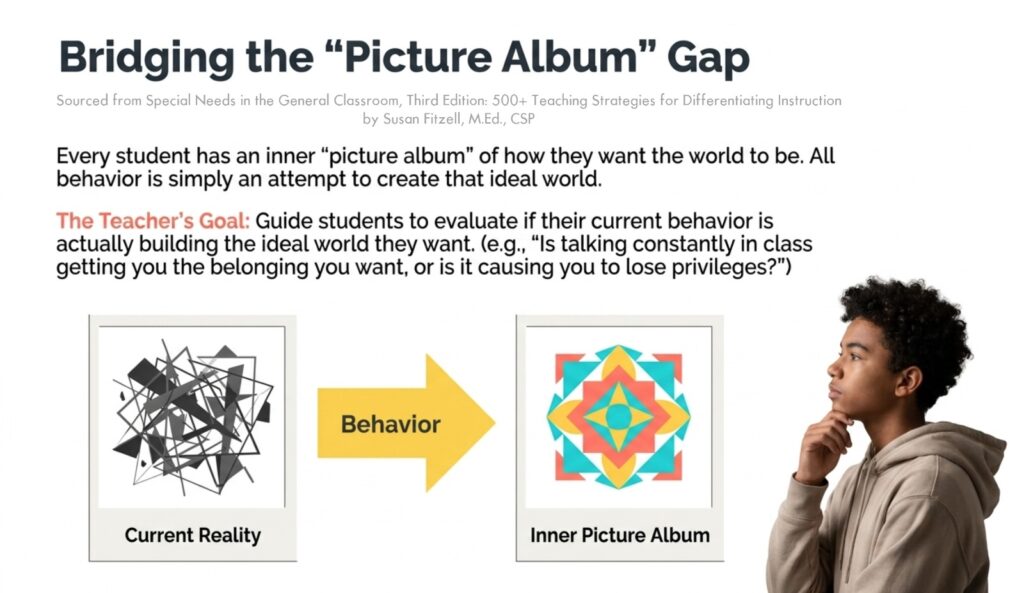
Our goal as educators is to get students to evaluate their present behavior and determine whether it is actually meeting their needs.
In one example, we might ask a student if their behavior is getting them what they want. If the student is talking constantly in class and loses a privilege, the student who wants belonging or fun is not getting what he wants through their behavior.
On the contrary, they are losing the thing they want and need. If the student is not getting what they need with their present behavior, making a specific plan for change is required. They must make a plan and a commitment to follow through with that plan. In my experience, students would prefer to be kicked out of class to sit in the office (which many find more entertaining than being in class) than sit with me and make a plan for better behavior!
As an adult, I do not do the choosing for the student. I may offer suggestions to help the student come up with solutions. Ultimately, the student must make the choice and commit to it. In this way, the student owns his behavior.
Guidelines for Discussion: The Win-Win Discipline Plan
*My work in this area was significantly influenced by Glasser’s Control Theory and Choice Theory philosophy and Kagan’s Win-Win Discipline framework.
When having these discussions, I find there are four key questions we need to address:
What were you doing that was unacceptable?
I found that asking “What is the problem?” which was how I learned the approach from Glasser’s work, often led to an answer like “I don’t know. I wasn’t doing anything wrong!” For me, “What were you doing that was unacceptable?” is a more direct, less vague, and more productive question. The purpose here is to focus on the specific behavior that’s causing the problem. Try to avoid confronting values or attitudes and just stick to the behavior.
Whose expectations are not being met?
This needs to be a part of the discussion. If it is the student’s own expectations, I might start with, “I am concerned”. If it is my expectation regarding rules, I simply state, “Part of my job as a teacher is to keep you safe” or “to create a safe environment. When you poke the student in front of you with scissors, that’s not safe.”
What do you want as a result of the conversation?
State what you want and word it in the form of a solution. Tell them, “I want to figure out a way that we both win”. Do not get sucked into arguing about the problem. Students are often skilled at avoiding responsibility. They resort to bantering, badgering, and blaming to get out of trouble.
What will the resolution include?
The resolution might include a plan for the future or logical consequences. Most importantly, the plan must include a commitment. If it does not, a new plan must be worked out that the student can commit to. When children are resistant to planning, I simply tell them that they will continue meeting with me after school (or another time) until we work it out and create a plan that we both feel comfortable with.
Yes, this took a lot of my time in the beginning. By January, Students knew that if they didn’t follow the rules we created and agreed to as a class, they would be stuck sitting with me to make a behavior plan. They felt that was worse than other consequences. I realize that some children are so attention starved they may want that time with you. That’s where you get to be creative in how you implement the framework.
Conclusion
I believe one of the most important things we can do is stop thinking about behavior only in terms of consequences and start thinking more proactively. When we make small changes to the environment, stay consistent without turning everything into a power struggle, and help students take ownership of their choices, we set everyone up for more success. This does not mean students should not be accountable. It means we address behavior in a way that is more likely to teach, support, and actually change it.If you are looking for more practical strategies you can use right away, I invite you to visit my free download page. I’ve put together additional tools and ideas to help you support struggling learners and make your classroom feel more workable again.
FAQ
What are proactive behavior supports in the classroom?
Proactive behavior supports are classroom strategies designed to prevent behavior problems before they escalate. Instead of reacting only after a student misbehaves, teachers use structure, consistency, seating adjustments, clear expectations, and problem-solving routines to help students stay regulated and successful.
How can classroom management support struggling learners?
Classroom management supports struggling learners when it reduces distractions, avoids unnecessary power struggles, and gives students tools to make better choices. Small environmental changes, flexible seating options, consistent routines, and behavior plans can help students focus, participate, and take more ownership of their behavior.
What is a win-win discipline plan?
A win-win discipline plan is a proactive problem-solving approach that helps students reflect on their behavior, identify what is not working, and commit to a better plan. The goal is not just punishment. The goal is to help the student make choices that meet their needs while also protecting the learning environment.
 | CLICK HERE to discover a wealth of teaching strategies and resources for maximizing student success!. Bring Susan to your campus!Featured seminar – Differentiation Strategies to Reach ALL Learners in the Inclusive Classroom |