
How different generations view diversity and neurodiversity
While many of us don’t consider the social striations between the generations relevant, the truth is there are distinct psychological differences between the Baby Boomers and the fresh new crop of Gen-Zs entering the modern workplace. Often, a company will have representatives from all generations working together.
How these psyches view diversity and neurodiversity is, naturally, quite varied. The things that challenged the Baby Boomers are not the things that challenge our co-workers who happened to be born after 1997.
My intent here isn’t to wade into the humorous pop culture cliches around the oddities of the different generations. Each generation, in response to their time pressures, developed positive skills and strengths. Humans are constantly growing, changing, and improving. The vocabulary of different generations evolves from each generation’s experiences in their formative years.
Is Gen-Z struggling?
By now, we’ve figured out that Boomers, Gen X-ers, and Millennials have much to offer society, but what about Gen-Z? From most of what I’ve seen in popular media and heard from some Gen-Z themselves, they call themselves the “snowflake generation” — easily triggered, easily hurt, embracing fluidity to a fault, anything goes. Pop culture isn’t doing them any favors. The world is a rough place for them, with limited resources in every area from finance to fuel — the same as it is for the rest of us. However, they’re the ones in the hot seat, having to deal with the fallout of this divided, pandemic-impacted, financially struggling world in the years to come.
Now, consider the neurodivergent Gen-Z members and their experiences growing up.
Generation Z has embraced neurodivergence
For example, even though neurodiversity has always existed in human society, we didn’t have a word for it until twenty years ago. Now, that word has evolved to include a wide range of differently-wired brains. Before the late ’90s, students who were neurodivergent (dyslexic, autistic, ADHD, etc.) were siloed in separate classrooms and educated by specially trained teachers. Most often, they were taught a less challenging curriculum.
That started to change in the United States in the early 1990s. Although there are still many schools in the US and other parts of the world that segregate neurodivergent students, today, the majority of youth are educated in a more inclusive environment. This means that Gen-Z and future generations are aware of, have an appreciation for, and are friends with neurodivergent students.
We didn’t have accommodations, or an understanding of the value of neurodiversity, until recently. Gen-Z has put this buzzword up in lights — perhaps to the chagrin of some who would love it if they didn’t make “such a big deal about it.”
But hold on — how many pre-1997 folks now recognize ADHD, dyscalculia, and dyslexia in themselves? Could they have benefitted from acknowledgment and support when their challenges arose? Of Course. Gen-Z has this advantage. Thanks to the fact that they have access to more information than we could imagine when we were their age.
There is more to be gained in collaboration than in resistance
It made me think of what Louis Armstrong says in the classic “What a Wonderful World.”
I hear babies cry
I watch them grow
They’ll learn much more
Than I’ll ever know
He was correct. They know much more than we do, and it’s time we accept and respect that. My big message has always been about seeking understanding, open acceptance, and learning from one another and our differences — because there is more to be gained in collaboration than in combat.
In researching this article, I found a plethora of Buzzfeed articles, many poking fun at Gen-Z. But there was one that was positively heartwarming and helpful. There were also insights about neurodiversity at work, too.
“I love that Gen-Z is destigmatizing mental health and seeking therapy! They talk about it so openly and seem less judgmental about the subject.”
— beedas89 on Buzzfeed
Gen-Z is flying the diversity flag boldly. Why? If we had become parents after the 90s, we all would have heard about ADHD, autism, dyslexia, etc. Those kids — they may be our own or their friends — are now adults trying to make it in life somehow. Many who were diagnosed may have battled to navigate the restrictive systems of education and socializing that made success hard for them. Those who went undiagnosed also fought — with unfair labels and the burden of dealing with a world that didn’t understand them yet. These were just some of the survival pressures they had to deal with.
Remember that this is also the generation with an acute awareness of social justice. Consider Greta Thunberg’s impact on the world. So naturally, they will speak up about their struggles. Not to gather pity but rather to raise awareness and improve things for everyone.
Gen-Z has expectations, and rightly so. Another Buzzfeed contributor mentioned their increased empathy, greater awareness of world issues, and willingness to demand fair treatment for everyone.
“I graduated from high school in 2005, which makes me an elder-millennial. I’m in my 11th year of teaching, and my group of 10-graders were all born in 2005, which blows my mind. They are very attuned to the current issues plaguing society and the planet, and if we do right by them, they’ll have the tools to be able to fix the things that we could not.”
— MissAmanda on Buzzfeed
Hannah Jewell makes her feelings known in her article, “Gen-Z workers should be proud of being ‘snowflakes’ rather than martyrs”
Hannah says:
“In my own experience, I saw the ways in which problems at work could be pinned on employees’ lack of character, fortitude, and work ethic rather than structural faults of the company. We brought up concerns about pay gaps along gender and racial lines, lack of transparency in raises and promotions, and lack of support for mental health. In response, we were given subscriptions to an app to sort out our mental health, but were expected to do it on our own time.”
Who’s to blame?
How very telling. What stands out to me is the ever-present anxiety about prejudice in the workplace. The lack of acknowledgment and support for mental health in the workplace provokes additional stress. Add bias about neurodiversity into this mix, and the picture is scary.
How can neurodiversity find acceptance, celebration, and a shift to a strengths or gifts-mindset at work if systemic, cultural problems in companies are blamed on the employees?
Forward-thinking employers would do well to rethink their mindset on these employee concerns. It’s a cop-out to throw the blame back on your employees! A failure to reflect on your company’s values will make it difficult to retain Gen-Z employees, especially those who are neurodivergent.
What does the data say?
Consider the implications of data gathered from the networking platform Tallo. A staggering 99% reported that workplace DEI is essential, with 87% responding that it is very important.
Tallo also found that accessibility and inclusion of people with disabilities, especially people who identify as neurodivergent, were crucial factors in Gen-Zers’ likelihood of applying for a job.
What’s more, Tallo Data Insights shows that 1 in 5 Gen-Zers have decided not to apply to a place of work because they lacked materials and resources for employees who identify as neurodivergent.
Given the benefits that neurodivergent people offer modern employers, is a lack of acceptance for neurodiversity tolerable?
It doesn’t do much for future-proofing against employee churn.
Looking at what’s behind “The Great Resignation”
In a 2021 survey conducted by Randstad UK, 69% of the 6000 employees in the inquiry said they’re ready to move jobs, with minimal worry about finding alternate employment. Why is this? Victoria Short, CEO at Randstad, references a few factors:
- Loyalty is a thing “of the past.”
- The pandemic fundamentally changed how people viewed life and work, resulting in a reevaluation of what they wanted from these areas. The “dream job” delusion has been shattered.
So, what is the material cost of employee churn at such unprecedented levels? According to research by Oxford Economics, the time it takes to effectively onboard a new employee is around 28 weeks — with an associated cost of £25,200 (or about $30 000) per employee. Not an insignificant cost if you look at the stats surrounding The Great Resignation.
The fundamental reasons motivating The Great Resignation are “soft.” And that’s a good thing. It’s a change in values, priorities, and the very fabric of the world we live in. The pandemic changed life’s texture, and people are looking at things very differently. It’s not just about money anymore. And no generation has been more disillusioned by the hollow allure of pure wealth than Gen-Z.
How Gen Z views neurodiversity
As we’ve seen, this generation is far less likely to tolerate the status quo, more so if it’s an unsustainable or toxic one. This is also the generation most aware of neurodiversity, having lived with it, promoted awareness of it, and understanding its actual impact and benefits. This generation knows that ADHD and autism aren’t just for boys. They know, too, that neurodiversity brings creativity and a fresh way of innovating in the workplace. They understand that diversity should lead to compassion and learning, not division and strife.
These are no trivial realizations. We all know the saying about the things we regret at the end of our lives, not being about money, work, and career. Few, in generations past, paid heed in a practical way. Gen-Z, as a group, has the audacity to act on the sentiment behind that saying. Why not act on that audacity? The most notable change comes from the audacious. Isn’t it high time we looked at a new way to do things? Perhaps this is the generation that will finally move us toward our humanity.
References
[a] Richardson, Liz (2021). Millennials Are Sharing Things They Actually Like About Gen Z’ers, And It’s Surprisingly Heartwarming, Buzzfeed. https://www.buzzfeed.com/lizmrichardson/gen-z-trends-millennials-like
[b] Jewell, Hannah (2022), Gen Z workers should be proud of being ‘snowflakes’ rather than martyrs, The Guardian. https://www.theguardian.com/commentisfree/2022/jan/27/gen-z-workers-snowflakes-bad-treatment-bad-pay)
[c] (2021), What Companies Need To Know About Gen Z’s Diversity, Equity, and Inclusion Expectations, Tallo. https://tallo.com/blog/gen-z-workplace-diversity-equity-inclusion/
[d] The great resignation: 69% of UK workers ready to move job (2021), Randstad UK. https://www.randstad.co.uk/about-us/industry-insight/great-resignation/
Neurodiversity Definition
Neurodiversity: this term refers to a general diversity of minds. It includes people who are neurotypical and neurodivergent. When I talk about promoting neurodiversity in the workplace, for example, I am referring to creating a diverse workforce representative of the broad spectrum that exists when it comes to ways of thinking, processing information, communication, and learning. Some employees may be “normal” or neurotypical while others may have ADHD, Dyslexia, Autism, or trauma impacted ways of thinking. I am not referring to any particular label or diagnosis, but rather, the concept of an environment where a diversity of minds coexist.
Neurodiverse: This word is pretty much the same as neurodiversity, but should be used as an adjective. You can say, for example, that your workplace is neurodiverse.
Be careful though, because you should never describe a person as being neurodiverse. Individual people should be described as neurodivergent.
Neurodivergent: This word describes an individual whose way of thinking falls outside of society’s defined version of normal. Oftentimes you will see it abbreviated as ND.
Many times, neurodivergent people will have a diagnosis or label you may recognize, like autism, dyslexia, or ADHD. But neurodivergent people are also those with epilepsy, different kinds of brain trauma, or simply a unique way of thinking that may not have a specific diagnosis.
CLICK HERE to visit the articles page.
 FREE DOWNLOAD: Neurodiversity in the Workplace: Things to Consider Before You Jump On the Bandwagon
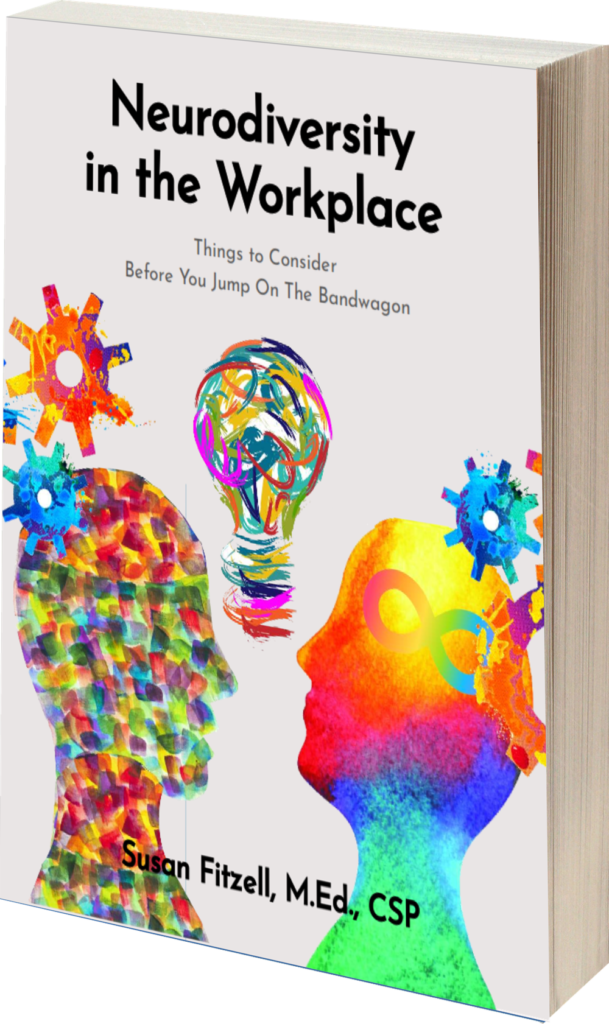 FREE DOWNLOAD: Neurodiversity in the Workplace: Things to Consider Before You Jump On the Bandwagon
Neurodiverse hiring practices can benefit any company in any industry and in more areas than most people realize. The investment has yielded greater patenting, innovation, process improvement, efficiency, and creativity not only in technology industries but also in industries that include investment banking, insurance, and mortgage banking.
This resource explains the term “neurodiversity” and describes the potential positive impact on your business that can come from including neurodivergent individuals in your workplace.
Download Neurodiversity in the Workplace! – Free!
Bring Susan Fitzell, M.Ed., CSP
Top Neurodiversity Speaker
To YOUR Organization!