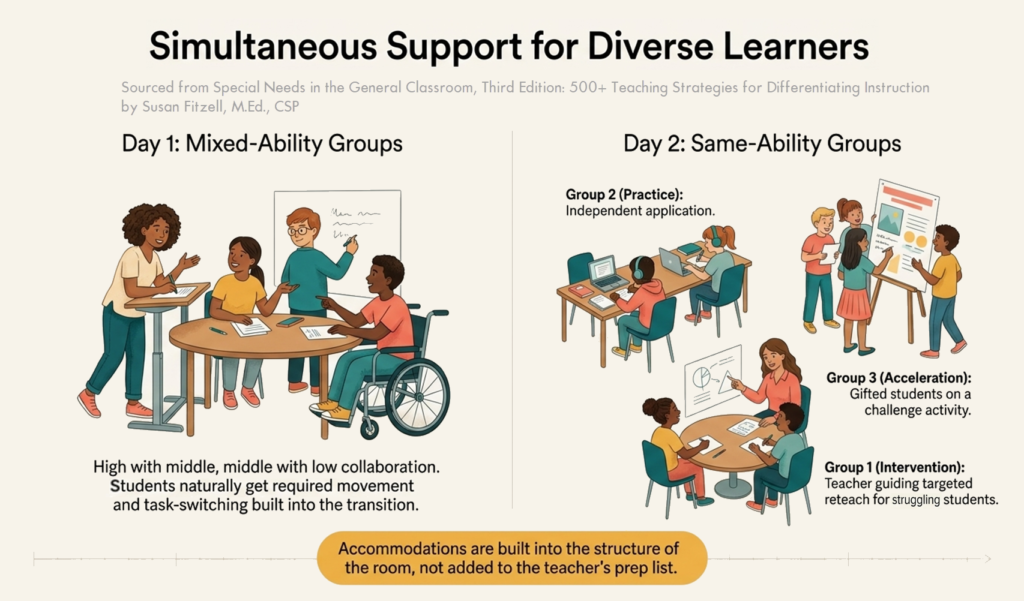
Part 2: How to Structure Lessons with Chunking Lesson Plans™.
A strong 10-minute core teach is clear, focused, and intentional. The time you save provides the time you need for practice, grouping, reteaching, and enrichment.
In Part 1, we looked at one of the biggest reasons lesson planning takes too long: teachers often try to solve every learning problem by extending whole-class direct instruction.
- You explain a concept.
- Some students look confused.
- You explain it again.
- A few students still look confused.
- So, you explain again.
Before long, 20 or 25 minutes of class time are gone. Some students are bored. Some students are still lost. Practice time has been squeezed. Grouping has had little room to be intentional. You leave class feeling as if you worked incredibly hard, yet still did not reach everyone.
That is exhausting.
And it is not necessary.
The answer is not to lower expectations. The answer is to change the structure.
- Teach the core concept.
- Stop.
- Check understanding.
- Group, practice, reteach, enrich.
- Pull students back together.
- Check again.
- Assign do-able homework.
That is the heart of Chunking Lesson Plans™.
How to Plan a 10-minute Core Teach
A 10-minute core teach must be focused.
This is not the time to explain everything you know about the topic. It is not the time to give every possible example. It is not the time to wander into interesting but unnecessary information.
Ask yourself:
- What is the essential concept students need today?
- What must all students understand?
- What vocabulary do they need?
- What is one strong example?
- What is one quick check for understanding?
- What visual, cue, or model will help students access the idea?
For example, if the objective is genre, the core teach might include:
- A simple definition of genre.
- Three examples of genre.
- A quick visual organizer.
- A “Which one is it?” check.
- One student-friendly explanation.
Then stop.
That is the hard part.
Teachers are used to filling space with more explanation. But more explanation is not always more learning.
Sometimes more explanation simply uses up the time that should have been available for practice, feedback, grouping, and intervention.
| A strong 10-minute core teach is not shallow. It is clear, focused, and intentional. |
What to do After the Core Teach
After the core teach, the lesson transitions to a reinforcement activity that engages students more directly.
That reinforcement might be movement into partner practice, same-ability groups, mixed-ability groups, independent work, teacher-led reteach, enrichment, or a quick formative assessment.
The point is that the teacher is no longer assuming (and hoping) that students understood the initial core teach.
Rather, the teacher uses student responses to decide what happens next.
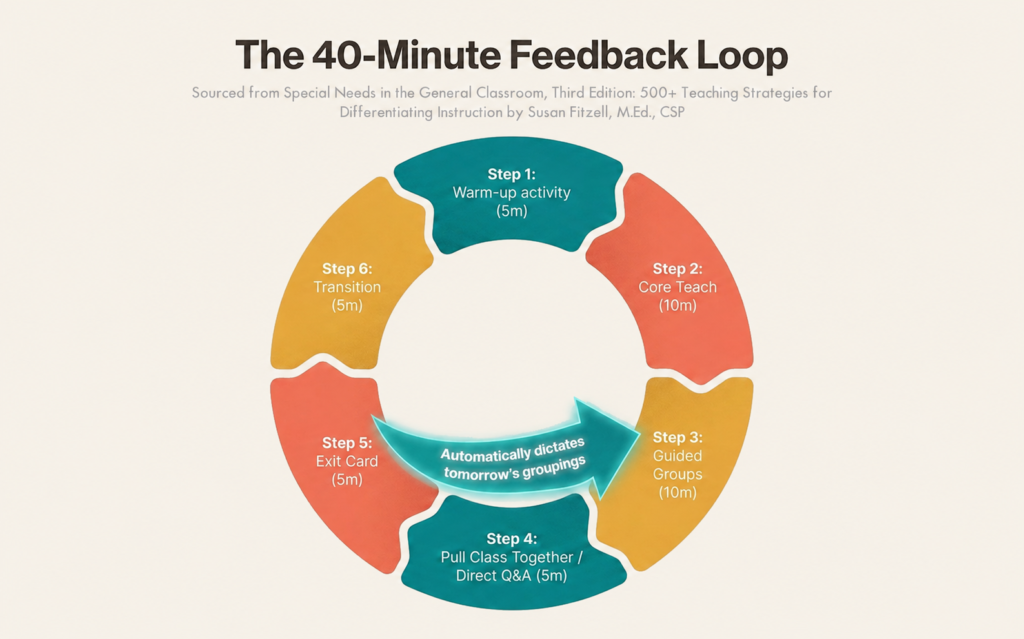
In a 40-minute class, the structure might look like this:
- Five minutes: warm-up
- Ten minutes: core teach
- Five minutes: quick formative check or “ticket” to see who has it and who does not
- Ten minutes: same-ability grouping, partner work, reteach, practice, or enrichment
- Five minutes: whole-class pull-back, Q&A, vocabulary review, or clarification
- Final minutes: ticket to leave, do-able homework, and closure
That is a very different lesson from 25 minutes of direct instruction followed by practice that has to fit into whatever time is left.
n the chunked lesson, the teacher is still covering the same core instruction. The difference is that the class is not trapped in one mode for too long.
- And the students who need acceleration? They accelerate.
- The students who need reteaching? They get reteaching.
- The students who need practice? They practice.
- The students who need enrichment? They are not sitting there waiting for the rest of the class to catch up.
This is not watered-down instruction. This is better use of instructional time.
What’s the Benefit of Chunking Lesson Plans™?
Here is what this might look like in real life.
Before Chunking the Lesson: the long direct-teach lesson
- Five minutes: warm-up.
- Twenty-five minutes: teacher explains the concept, gives examples, repeats examples, asks questions, tries to pull students into discussion, notices confusion, explains again.
- Ten minutes: limited time for practice.
- Three minutes: assign homework.
- Two minutes: closure, if there is time.
What is often the result?
Some students are bored. Some students are still confused. Practice is too short. The teacher does not have enough information to group students well. Homework may go home before students are ready to do it independently.
After Chunking the Lesson:
- Five minutes: warm-up.
- Ten minutes: focused core teach.
- Five minutes: quick check for understanding.
- Ten minutes: targeted practice, partner work, reteach group, or enrichment group.
- Five minutes: pull class back together for review, vocabulary, or clarification.
- Three minutes: ticket to leave.
- Two minutes: do-able homework and closure.
What is often the result?
The teacher gets formative assessment data sooner. Students move into practice sooner. The students who need more support get it. The students who are ready to move on are not held back. The teacher is not trying to solve every learning issue through whole-class explanation.
That’s the difference.
Start With Two Days per Week
Teachers don’t have to overhaul every lesson immediately.
In fact, I recommend starting with this structure just two days a week. Consecutive days are best. Avoid a Friday and Monday scenario because too much time falls between the initial instruction and the group instruction.
Once teachers see how much more efficiently the class runs, they can build from there.
For block scheduling, the same idea applies. A longer block can be treated as two shorter chunks. The first 40 minutes might function like “day one,” and the second 40 minutes might function like “day two.” Teachers can use a quick formative assessment in the middle to determine who needs reteaching, practice, or enrichment.
The key is to keep the lesson moving in purposeful chunks.
Keep chunks under 12 minutes whenever possible.
Plan Once for Access, Not Endless Reteaching
Teachers are exhausted.
They don’t need one more complicated initiative. They don’t need to write three separate lesson plans for one classroom or spend hours creating materials that still don’t meet students where they are.
They need structures that work.
Chunking Lesson Plans™ gives teachers that structure.
| Teach the core concept. Stop. Check understanding. Group, practice, reteach, enrich. Pull students back together. Check again. Assign do-able homework. |
That’s not watered-down instruction. Rather, it’s instruction with purpose.
And when we plan this way, we spend less time catching students up later.
Instead, we plan once for access.
Video: How to Make Lesson Planning Faster
Source note: Adapted from Susan Gingras Fitzell, Special Needs in the General Classroom: 500+ Teaching Strategies for Differentiating Instruction, especially the sections on Chunking Lesson Plans™
FAQ
What is Chunking Lesson Plans™?
Chunking Lesson Plans™ is a lesson structure that breaks instruction into smaller, purposeful sections. Instead of spending most of the class on whole-group direct teaching, the teacher delivers a focused core teach, checks understanding, and then uses the remaining time for practice, grouping, reteaching, enrichment, and closure.
How does chunking make lesson planning faster?
Chunking makes lesson planning faster because it gives teachers a clear structure for how to use class time. Instead of planning one long direct-teach lesson and then trying to fit in practice afterward, teachers plan a short core teach followed by targeted next steps based on student understanding. This reduces overexplaining and makes differentiated instruction more manageable.
Why is a 10-minute core teach effective?
A 10-minute core teach is effective because it keeps instruction focused on the essential concept students need to learn that day. It gives students enough information to begin learning without overwhelming them, and it preserves time for practice, formative assessment, reteaching, and enrichment.
Want more practical support for teachers?
I offer professional development for schools on co-teaching, collaboration, learning strategies, and supporting students who learn differently.
Education Programs & Workshops
Co-Teaching Training / Consulting
Free educator download
Substack sign-up
If you are here because you care about supporting teachers, you may also like:
Co-Teaching Support for Schools
Practical Learning Strategies for Struggling Students
Paraprofessionals and Teachers Working Together – Unlocking the Power of Collaboration for Student Success