Part 1: When More Explaining Leaves Less Time for Practice
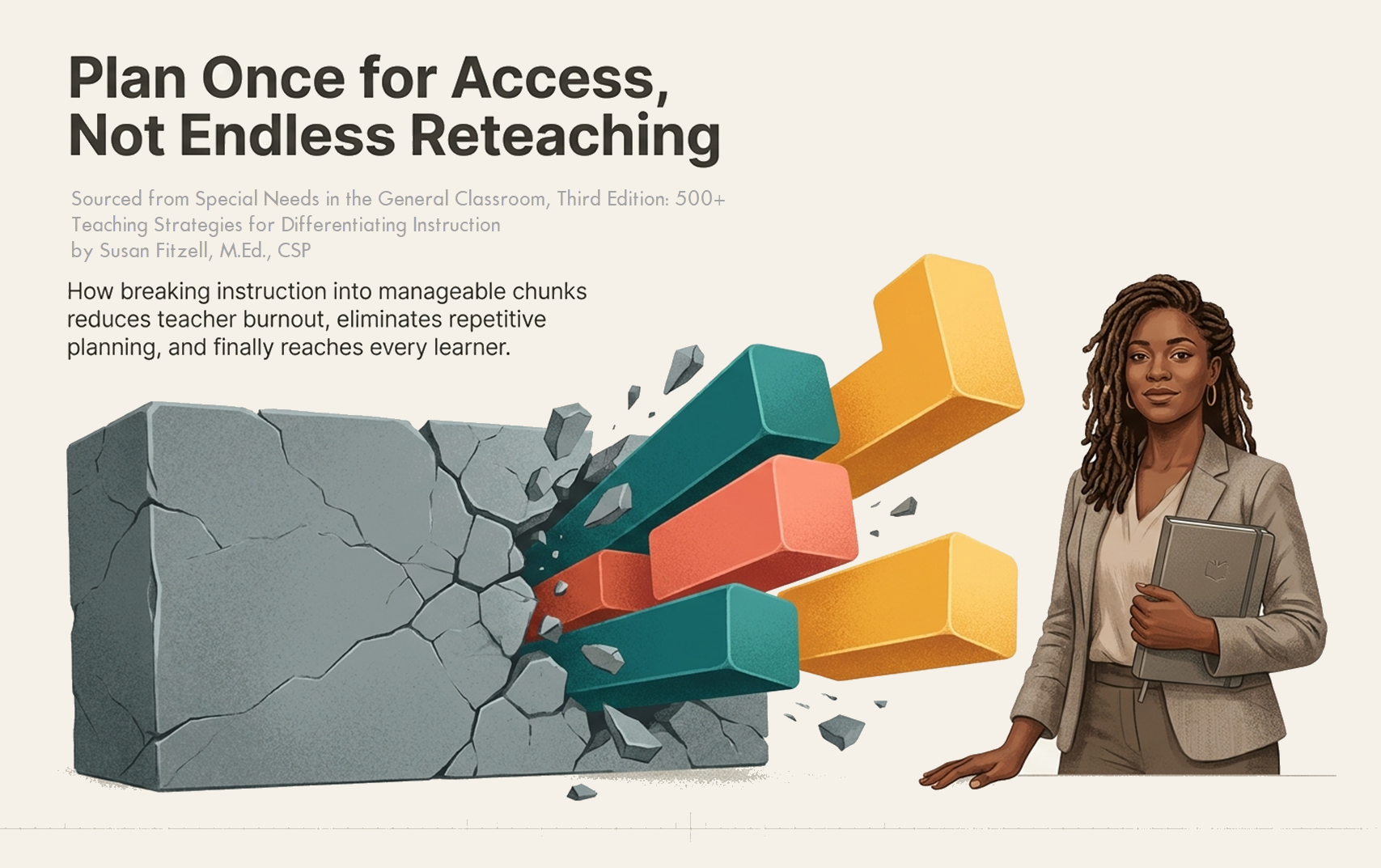
Teachers are already working hard to plan meaningful lessons and support all learners. Chunking makes that work more effective by breaking instruction into smaller, purposeful sections that give students more chances to process, practice, and succeed.
Teachers ask me all the time, “How can I make lesson planning faster?”
My answer is usually not what they expect.
I don’t tell them to find a shortcut that waters down the lesson. I don’t tell them to lower the bar. I don’t tell them to create three completely different lesson plans for one class period. Who has time for that?
Instead, I ask them to look at the structure of the lesson.
Because often the problem is not the teacher’s work ethic. It is not that the teacher does not care enough, plan enough, or try enough.
The problem is that the lesson is planned as one long teach instead of a series of smaller, purposeful chunks.
And that matters.
When I work with teachers in inclusive classrooms, I see the same pattern again and again.
A Typical Scenario
A teacher starts with a clear objective. The lesson begins well. The teacher explains the concept, gives examples, asks questions, and checks faces around the room.
Then the teacher sees it.
Jessica has that glazed look in her eyes. David is looking puzzled. Rob, who is on an IEP, is just kind of “out there” at this point.
So, being a caring teacher, the teacher keeps teaching.
They give another example. Then another one. They ask more questions, hoping to pull students in. They try to get participation going, but it feels like pulling teeth because the same students are answering over and over again.
By now, 20 minutes of class time has gone by and they still are direct teaching. Maybe they’ve included visuals or used dramatic role-play to engage. Maybe they’re doing outstanding direct teaching.
Still, some students are lost.
So they keep going.
Now 25 minutes are gone. In a 45-minute class, that leaves only 20 minutes for practice, application, grouping, reteaching, enrichment, closure, or whatever else was supposed to happen.
So, here is the question that stopped me in my tracks when I first started thinking deeply about Chunking Lesson Plans™:
| What were the capable students doing during those extra 15 minutes? |
Probably thinking, “Oh, geez. I’m bored.”
And who knows? They may have even begun to act out their boredom and frustration.
At the same time, after 25 minutes of direct teaching, there are probably still students who need more practice. There may still be a handful of students who have no clue what the concept means.
So, weren’t we in almost the same place after 10 minutes of direct teaching?
Why did we spend 25 minutes only to be at the same place we were in after ten?
What an epiphany this was for me.
That realization is the heart of Chunking Lesson Plans™.
The goal is not to teach less. The goal is to use whole-group teaching where it helps most, then give students time to process, practice, and apply.
Direct teaching is a best practice technique. Ten minutes, done well, is powerful. But after that, we need to do something different.
We need to chunk the lesson.
Why Lesson Planning Feels So Overwhelming in Inclusive Classrooms
Inclusive classrooms are complex.
In one room, a teacher may have students who are reading above grade level, students reading two or three years below grade level, students with IEPs, students with ADHD, students with auditory processing difficulties, English learners, anxious students, gifted students, students who need movement, students who need visuals, and students who need time to think before responding.
Teachers are expected to teach the grade-level standards, provide accommodations, keep students engaged, manage behavior, assess understanding, provide intervention, enrich advanced learners, and document what is happening.
No wonder lesson planning feels overwhelming.
Teachers do not need one more complicated form to fill out. They need something that visually cues them into remembering the methods they might use to meet the needs of all learners in the classroom.
That is where a planning tool matters.
The goal is not to make teaching mechanical. The goal is to reduce the mental load.
Instead of sitting there thinking, “What am I forgetting?” the teacher can glance at a visual planning reminder and ask:
- How will students access the information?
- How will they practice?
- How will they show understanding?
- What supports will help students who struggle?
- What options will keep students engaged?
That saves time.
Not because the teacher is doing less thinking, but because the teacher is not starting from scratch every time.
What Often Happens: Direct Instruction Expands, and Practice Time Shrinks
This is where lesson planning can get tricky:
A whole-class lesson often assumes that everyone needs the same amount of direct instruction, even when students are starting from different places.
Then, when some students do not get it, the teacher gives the whole class more direct instruction.
That feels responsible. It feels caring. It feels like we are not leaving anyone behind.
But in reality, we may be holding some students back while still not giving struggling students the kind of support they actually need.
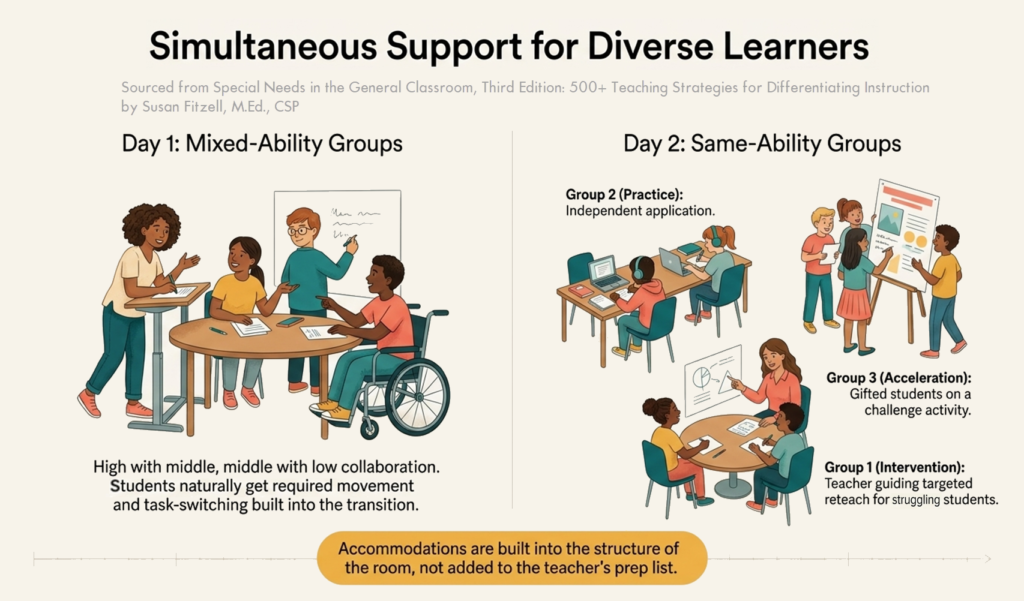
Some students do not need another whole-class example. They need a smaller group. They need a different modality. They need to talk it through with a partner. They need to manipulate something. They need vocabulary clarified. They need the steps color-coded. They need to see the concept mapped out. They need guided practice.
Other students already have it. They need acceleration, enrichment, application, or an opportunity to go deeper.
When we keep reteaching the whole class, we often create two problems at once:
- The students who understand become bored.
- The students who do not understand still do not get enough targeted support.
That is why chunking matters.
What Chunking Lesson Plans™ Solves
Chunking Lesson Plans™ helps teachers use class time differently.
Instead of thinking, “I have to explain until everyone gets it,” the teacher thinks, “I am going to teach the core concept clearly and briefly, then use the rest of the lesson to find out who needs what.”
That one shift changes everything.
Let’s use the example from my book: teaching genre.
If I have five on-grade-level capable students with no learning disabilities in a small group, and I want to teach them the concept of genre, not to be experts on it, but to know what genre is and identify three types, most teachers would agree that I could teach that concept in about ten minutes.
So why do we often take 25 minutes in a whole-class lesson?
| Because we are trying to solve individual learning needs with whole-class teaching. |
Chunking helps us stop doing that.
Instead, how about we teach the core instruction for about ten minutes and then stop. No matter how many glazed looks we see, we stop.
Not because we are abandoning students.
But, because we are moving them into a structure where we can actually help them better.
The Takeaway for Part 1
Faster lesson planning should not mean weaker instruction.
It should not mean copying a worksheet and hoping for the best.
It should not mean lowering expectations for students who struggle.
It means designing the lesson so that the teacher is not trapped in 25 minutes of direct instruction when 10 minutes would have been enough to launch the learning.
My whole philosophy is built around the idea that strategies can be good for all and critical for different learners.
Chunking Lesson Plans™ is one of those strategies.
It helps the teacher stop reteaching the whole class longer and longer and start using class time more intentionally.
In Part 2, we will look at how to plan the 10-minute core teach, what to do after that first chunk of instruction, and how to use the Lesson Planner Idea Jogger to make differentiated planning faster and more manageable.
Podcast: Stop Overexplaining with Ten Minute Chunks
Source note: Adapted from Susan Gingras Fitzell, Special Needs in the General Classroom: 500+ Teaching Strategies for Differentiating Instruction, especially the sections on Chunking Lesson Plans™ and the Differentiated Planning – Lesson Planner Idea Jogger.
FAQ
How can teachers make lesson planning faster without lowering expectations?
Teachers can make lesson planning faster by changing the structure of the lesson, not the rigor of the content. When instruction is chunked into smaller, purposeful sections, teachers can spend less time overexplaining and more time giving students opportunities to process, practice, and apply what they are learning.
Why does direct instruction sometimes take too much class time?
Direct instruction often stretches too long because teachers are trying to meet individual learning needs through whole-class teaching. When some students look confused, teachers naturally keep explaining. The problem is that this can reduce time for practice and still fail to provide the targeted support struggling learners actually need.
What is the benefit of chunking lesson plans in inclusive classrooms?
Chunking lesson plans helps teachers use class time more intentionally. A short, focused core teach gives students the foundation they need, and the rest of the lesson can be used to identify who needs practice, reteaching, enrichment, or a different way to access the content. This makes differentiated instruction more manageable in inclusive classrooms.
Want more practical support for teachers?
I offer professional development for schools on co-teaching, collaboration, learning strategies, and supporting students who learn differently.
Education Programs & Workshops
Co-Teaching Training / Consulting
Free educator download
Substack sign-up
If you are here because you care about supporting teachers, you may also like:
Co-Teaching Support for Schools
Practical Learning Strategies for Struggling Students
Paraprofessionals and Teachers Working Together – Unlocking the Power of Collaboration for Student Success