
Scripts for Hard Conversations Without Damaging the Relationship
The Reality of the Co-taught Classroom
If you asked me, “What is one thing you should never say to your co-teacher?” my reply would be, “Don’t announce to the class that you are superior, and your co-teacher is inferior.”
I was co-teaching biology with a Biology teacher who could say the meanest things with a smile on his face. One day, I was teaching the parts of the heart. When I finished explaining the difference between the inferior vena cava and the superior vena cava, he told the class, “Yes, it is just like Mrs. Fitzell and I. She’s the inferior vena cava, and I’m the superior vena cava.”
The class laughed. I felt humiliated, diminished, and betrayed.
Months later, when we were reviewing the eye, which has an inferior oblique and superior oblique, he repeated the analogy again. He thought it was funny. I thought it was mean.
These were two of the most humiliating experiences I had while co-teaching because he said these things in front of the entire class.
This story shows how easily a relationship is damaged in front of students. The fastest way to ruin a partnership is to act superior in the classroom. When one teacher is treated like an assistant, the students notice. They stop seeing that person as a real teacher. This post provides practical language to handle these hard moments. You can say the hard thing without damaging the professional bond. It all comes down to one thing: parity.
Understanding Parity in Plain English
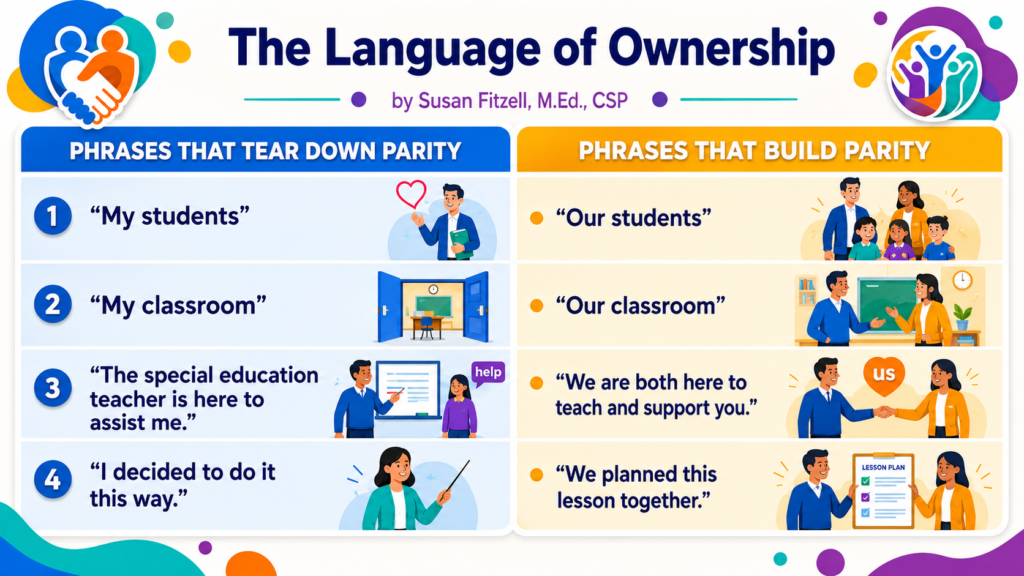
Parity is a state where both teachers are respected and valued. It means students see both adults as active participants in their education. When parity exists, neither teacher is just a helper. Both own the classroom. One small change in your wording can build this respect. Use the table below to shift from solo ownership to shared leadership.
Once you share ownership of the room, you need to look at the specific words you use in your daily interactions.
The Power of “And” Over “But”
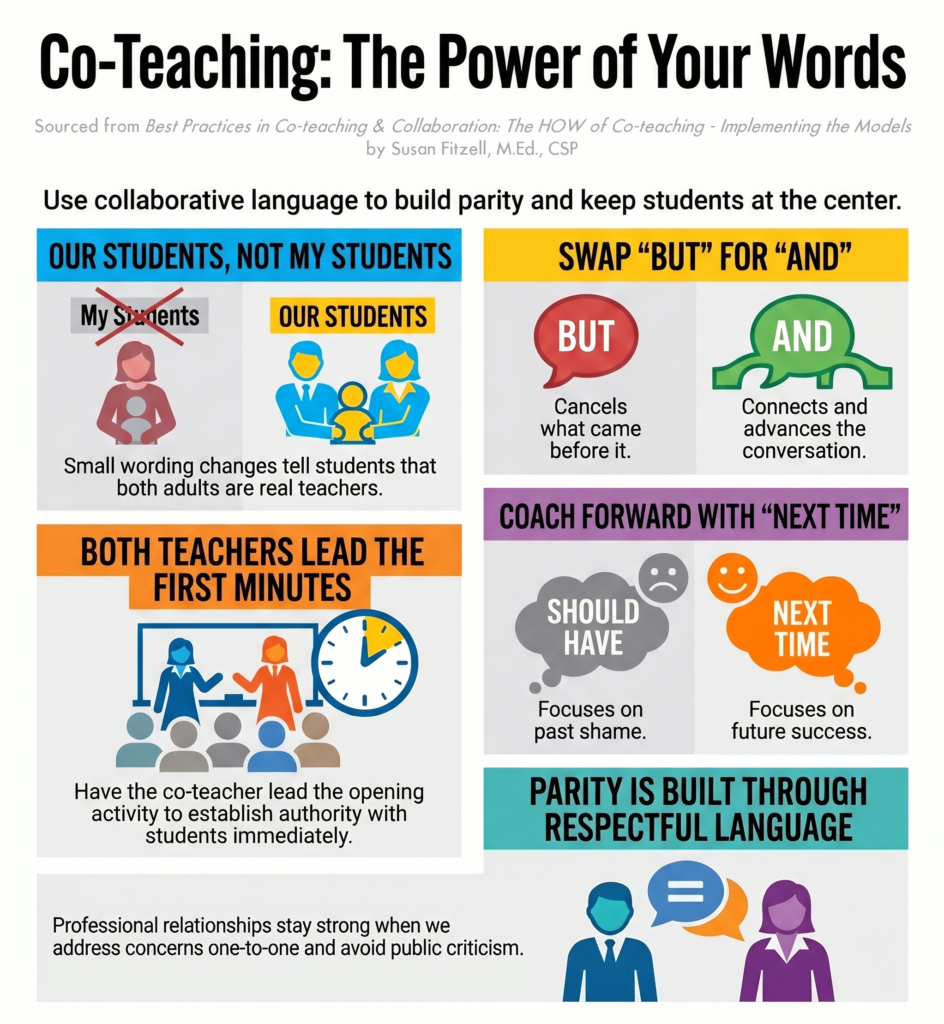
There is a “No Buts About It” rule in collaboration. The word “but” usually cancels everything you said before it. It acts as an anchor for an argument. The word “and” is different. It acknowledges the other person. It connects your thought to theirs and allows the conversation to move forward.
Consider these three pivots:
- The “Hard Work” Shift: Instead of “I know you worked hard, but the students were confused,” try, “I know you worked hard, and I noticed students were confused during independent practice.” This makes your colleague feel acknowledged rather than dismissed.
- The “Idea” Shift: Instead of “That is a great idea, but we don’t have time,” try, “That is a great idea, and let’s decide where it fits in the plan for this week.” This treats the idea as a contribution instead of a burden.
- The “Planning” Shift: Instead of “I know you are busy, but we have to plan,” try, “I know you are busy, and we need a planning routine so students benefit from both of us.” This focuses on a shared goal instead of a personal demand.
Small shifts like these move the focus from past mistakes to future success.
Coaching the Future vs. Shaming the Past
There is a big difference between criticizing and coaching. Criticism uses “should have” and focuses on the past. No one can change the past. This phrasing only causes resentment and shame. Coaching focuses on “next time” or “in the future.”
“You can’t build a relationship with a hammer.”
Use these three coaching pivots to protect your colleague’s professional face. Always try to request instead of giving orders.
1. On Complexity: Change “You should have thought about how hard this was” to “Next time, let’s think through the complexity before we execute.”
2. On Changes: Change “You should have told me you were changing the activity” to “Next time, please let me know before the activity changes. I want to support the students well.”
3. On Orders: Change “You’ll have to do the accommodations” to “Could you please review the accommodations so we both know what students need?”
These phrases maintain trust because they offer a path forward. When we are frustrated, our words tend to stretch the truth.
Watching for Language “Warning Lights”
Certain words act as warning lights. When you say “never,” “always,” or “no one,” you are likely speaking out of frustration. These words are rarely facts.
“Exaggeration is truth that has lost its temper.”
Swap these extremes for specific facts:
- The Attendance Issue: Instead of “You never attend co-planning sessions,” try “This is the second time we missed planning together. We need both our areas of expertise there.
- The Materials Issue: Instead of “You are always late with materials,” try “This is the second time the materials were not ready. Please let me know in advance if the plan changes.”
Specifics allow for a calm conversation. You can start showing this respect in the first few minutes of the school day.
The Five-Minute Parity Plan
A simple way to build authority is to have the co-teacher lead the first five minutes of class. This teacher can lead a review activity while the other teacher observes. This small shift creates several benefits:
- Students see the co-teacher as a leader. They see a credible authority.
- The teacher leading the review learns the content more deeply.
- The teacher who is not leading has time to collect student data.
- Students get a review using methods other than a verbal-linguistic lecture.
Public leadership is vital, but private communication must remain the priority.
Closing: Practicality Over Perfection
These scripts are starting points. They are not magic words. You must deliver them in a calm tone without any hint of sarcasm. A respectful sentence said with sarcasm will still damage a relationship.
These scripts are starting points. They are not magic words. You must deliver them in a calm tone without any hint of sarcasm. A respectful sentence said with sarcasm will still damage a relationship.
Don’t try to fix everything in one day. Pick one phrase and try it. The goal is not to win an argument. The goal is to keep enough trust in the relationship so you can both serve your students. Professional relationships stay strong when we address concerns one-to-one and keep respect at the center of the room.
Video: What to Say to Your Co-Teacher | Co-Teaching Communication and Parity
FAQ
What should I say to my co-teacher during a hard conversation?
Start with language that protects the relationship while addressing the issue directly. Use specific observations, focus on future solutions, and frame concerns around shared goals for students. Phrases like “Next time, let’s…” or “I noticed…” are more productive than blame-based language.
Why is parity important in a co-taught classroom?
Parity matters because students notice how teachers treat one another. When one teacher is seen as less important, the classroom relationship weakens and student respect can shift. Shared language, shared leadership, and mutual respect help both teachers maintain credibility and support students more effectively.
How can co-teachers handle conflict without damaging the relationship?
Co-teachers can handle conflict more effectively by speaking privately, using calm and specific language, avoiding exaggeration, and focusing on what should happen next rather than attacking what already happened. Respectful communication helps preserve trust while still addressing real concerns.
Want more practical support for teachers?
I offer professional development for schools on co-teaching, collaboration, learning strategies, and supporting students who learn differently.
Education Programs & Workshops
Co-Teaching Training / Consulting
Free educator download
Substack sign-up
If you are here because you care about supporting teachers, you may also like:
Co-Teaching Support for Schools
Practical Learning Strategies for Struggling Students
Paraprofessionals and Teachers Working Together – Unlocking the Power of Collaboration for Student Success