We survived a global crisis only to voluntarily drag our best talent back into environments guaranteed to break them. Think about that for a second.
For a brief period during the pandemic lockdowns, people who process the world differently finally had control over their workspace. They thrived. Now we are forcing them back into the sensory nightmare of the open plan office. And company leaders are genuinely baffled as to why their people are disengaged.
Return-to-office mandates and rigid workplace systems often undermine neurodivergent employees by prioritizing conformity over capability.
This profound disconnect was the focus of a recent feature by Cath Everett for Diginomica. She examined a startling new report by City and Guilds that exposed a massive gap in the modern workplace. Senior leaders are highly confident they are providing excellent support for their workforce. But the employees on the ground report a completely different reality. There is a widening chasm between corporate intent and lived experience.
I spoke with Cath for the feature, and I pointed out one of the biggest drivers of this gap. Awareness moves faster than implementation. But there are other factors too, one of which is tech companies’ widespread return to office mandates. As I explained in the article:
“During COVID, people started working from home and many neurodiverse people found life became easier as they didn’t have someone sitting on either side of them and could do things like adjust the lighting to suit themselves. Even when they had to return to the office for one or two days a week, it was bearable. But many employers are now forcing people back full-time, which can be a nightmare if you have ADHD or autism.”
What Employers Still Get Wrong
Organizations confuse activity with results. You can hold all the inclusion seminars you want. You can write sweeping corporate policies and celebrate your diversity initiatives in marketing brochures. But if you demand absolute conformity in how work gets done on a Tuesday afternoon, your policies are useless.
Employers are still operating from a deficit mindset. They look at someone who struggles with harsh fluorescent lights or the constant chatter of an open floor plan and they see a broken employee. They see a problem to fix.
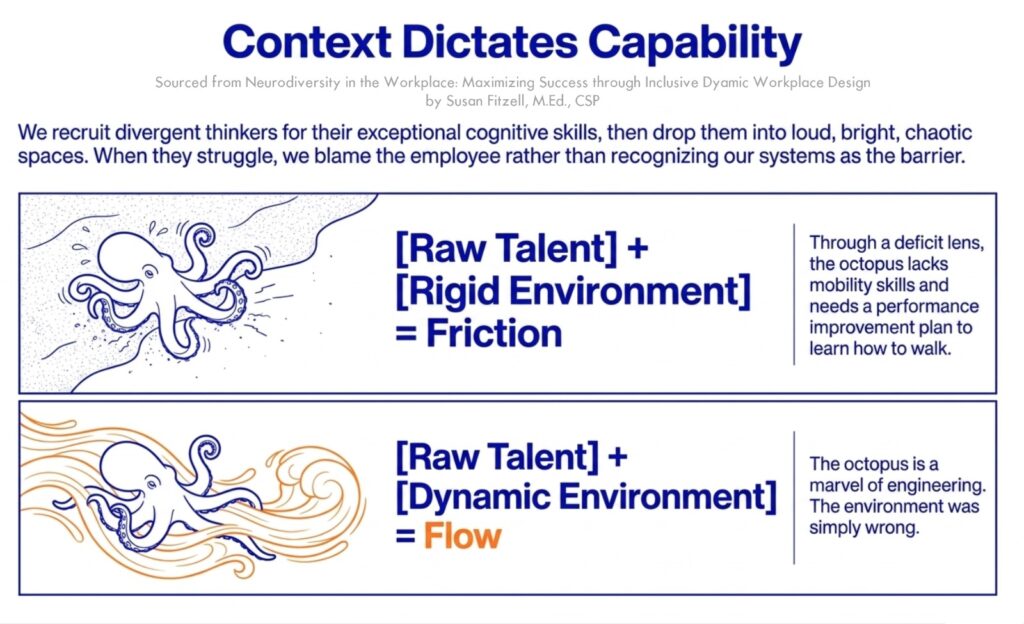
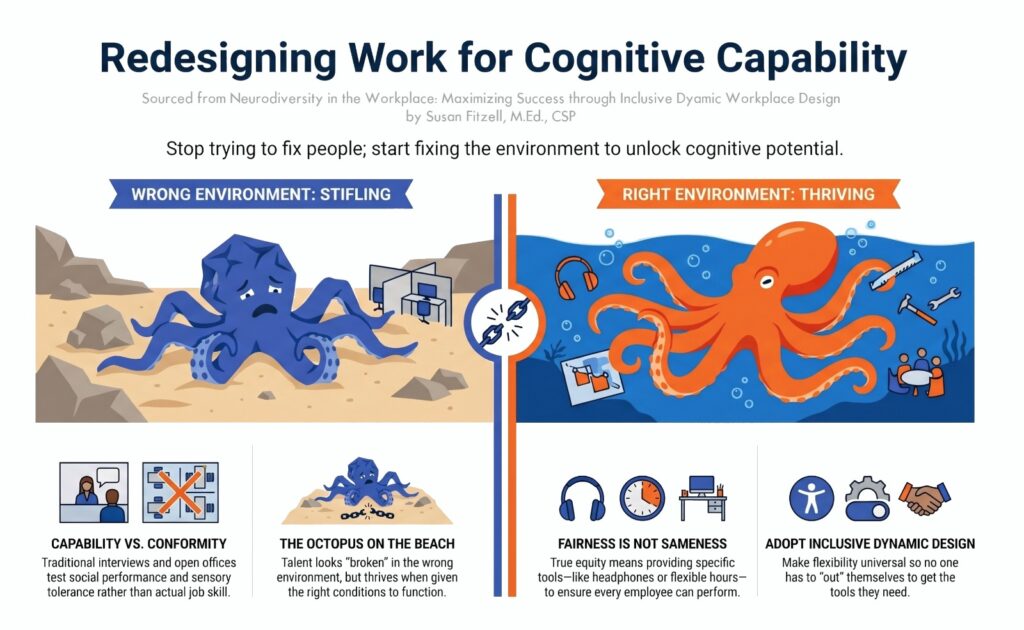
We are essentially pulling an octopus out of the ocean and dropping it onto the beach. On the sand, the octopus looks clumsy. It struggles to move. Through a deficit lens, you might conclude the octopus lacks mobility skills. You might even put it on a performance improvement plan to teach it how to walk. The reality is the octopus is a marvel of engineering. The environment is just wrong. Put it back in the water and watch what it can do.
We do this constantly in the corporate world. We recruit divergent thinkers for their exceptional cognitive skills. Then we drop them into loud, bright, chaotic spaces and expect them to seamlessly assimilate. When they struggle, we blame the employee. We fail to recognize that our own systems are the barrier. We expect people to be superhuman in their output while ignoring their basic human biology.
This obsession with conformity starts before a person is even hired. What employers still get wrong is relying on the traditional job interview. Standard interviews are just mini performances. They test how well a candidate makes small talk, holds eye contact, and mirrors the interviewer. They do not test how well a person can actually do the job. A brilliant software developer might freeze when forced to answer multi part verbal questions on the spot. If you reject them for a lack of social polish, you are filtering out your most innovative thinkers. You are actively choosing conformity over capability.
Why Return-to-Office Policies Hurt Neurodivergent Employees
This is not about making people feel warm and fuzzy. This is a conversation about business survival and the staggering cost of lost potential.
When you force people to work in ways that fight their natural wiring, they have to compensate. They spend massive amounts of energy just trying to look normal. They hide their struggles. Every ounce of energy a person spends trying to block out background noise or navigate unwritten social rules is energy stolen from problem solving.
It leads straight to burnout. Your top performers become exhausted. Output drops. Eventually, they leave and take decades of institutional knowledge straight to your competitors.
This loss of talent is entirely preventable. Consider a top performing sales representative I worked with. Let us call him Ben. Ben was brilliant at connecting with clients. He understood his product inside and out. But Ben is a divergent thinker who struggles with dense, text heavy reading. He successfully hid his dyslexia for decades. Then his company rolled out a new learning management system requiring timed written tests to earn product certifications.
When Ben took the tests, the letters flipped on the screen. He begged senior management for an alternative way to prove his product knowledge. They refused. The rules were the rules. Ben left the company. They lost their best salesperson because they prioritized a rigid testing system over actual job capability. The cruel irony is that his company had a highly publicized hiring initiative for different thinkers. They celebrated inclusion in theory but refused to offer a simple adjustment in practice.
The impact is even more severe for women in middle management. Society teaches girls to hide their differences from birth. They learn to turn their distress inward to avoid making waves. By the time a neurodivergent employees reaches middle management, she is completely depleted from a lifetime of masking. If she asks direct questions to understand a project, she is labeled difficult. If she concentrates hard, her intense facial expression is misread as anger. Workplaces operating on traditional power based norms marginalize these brilliant minds every single day.
We see this frequently in the tech sector with the superpower stereotype. Companies want to hire a brilliant coder, but they expect a savant. They expect superhuman capabilities combined with seamless social assimilation into a fast paced culture. When the employee inevitably struggles with the sensory environment, the company is entirely unprepared to support them. We are leaving performance on the table. We are stifling innovation because we are too stubborn to rethink how work gets done.
Moving Beyond Labels and Designing for Capability
The solution is not to create special categories or stick clinical labels on people. In fact, labels often do more harm than good. They trigger unconscious bias. They make people feel othered. Most of your divergent thinkers will never disclose their struggles because they fear being stereotyped. They do not want to be the office poster child for an inclusion initiative. They just want to do their jobs.
When I speak with leaders about making changes, they almost always bring up fairness. They tell me they cannot let one person wear headphones or work from home because it would not be fair to everyone else. They fundamentally misunderstand what fairness actually means.
Imagine you are on a flight for a solo business trip. You are stuck in a middle seat. The air is hot. The person behind you is kicking your chair. A baby is crying non stop. The smell of fast food is wafting through the cabin. You have a critical report to finish before you land. You have two choices. You can grit your teeth, suffer through sensory assault, and produce terrible work. Or you can put on a pair of noise canceling headphones so you can focus.
If you put those headphones on, is that favoritism? Are you getting a special perk? No. You are using a tool to function. True equity means giving people the specific tools they need to do their best work. Forcing everyone to work under the exact same conditions is not fair. It is destructive.
Why Inclusive Workplace Design Works Better
We need to stop trying to fix the people and start fixing the environment. I call this Inclusive Dynamic Workplace Design™. It is a philosophy built on common sense and flexibility.
Make adjustments universally. If flexible hours help one person, offer them to everyone. If someone needs to sit in a dimly lit work area to be productive, give them the go ahead. Create quiet chill spaces in the office where anyone can escape sensory overload. When you make flexibility the standard, nobody has to out themselves just to get the tools they need. You eliminate the whispers about favoritism entirely.
This design shift must extend to how we share information and collaborate. Not everyone learns by listening to a manager speak at the front of a room. I once worked with a vice president who had a lead developer on her team. During a critical Zoom meeting to solve a complex issue, the developer kept her head down the entire time. She barely spoke. The vice president could have assumed she was disengaged and called her out. Instead, she waited. Near the end of the meeting, she asked the developer if she had anything to add.
The developer looked up and said she had been mapping out the conversation. She held up a hand drawn flowchart she created while listening. She had successfully identified the break in the process by visually mapping out the problem. That is the kind of capability we unlock when we stop forcing people to look and act like traditional employees.
How to Design for Capability Instead of Compliance
If you want to bring different minds into your company, switch to skills based assessments instead of traditional interviews. Give candidates the interview questions in advance. Allow them to process the information so you get their best answers, not just their fastest ones. Partner with candidates to discover their natural strengths rather than searching for their flaws.
The ground beneath us will always shift. We cannot control that. But we can absolutely control the environments we build on top of it. The future belongs to organizations that let go of forced conformity. When you shift from a deficit mindset to a gifts mindset, you clear the path for raw talent to thrive. You build a high performance culture where every mind can contribute. Get the octopus back in the water. Let your people do what they do best.
FAQ
Why do return-to-office policies affect neurodivergent employees differently?
Return-to-office policies can create added barriers for neurodivergent employees because many office environments include sensory overload, constant interruptions, bright lighting, noise, and social demands that make concentration and regulation more difficult. Remote or flexible work often gives people more control over their environment and working conditions.
What is inclusive workplace design?
Inclusive workplace design is the practice of creating work environments, policies, and communication systems that support different ways of thinking, processing, and working. This can include flexible schedules, quiet spaces, alternative ways to share information, and options that reduce unnecessary barriers to performance.
Why is forced conformity bad for business?
Forced conformity can lead to burnout, disengagement, lower productivity, and higher turnover. When companies prioritize looking like a “traditional employee” over actual capability, they risk losing highly skilled people who could otherwise make strong contributions.
References
https://neurodiversityintheworkplace.guru
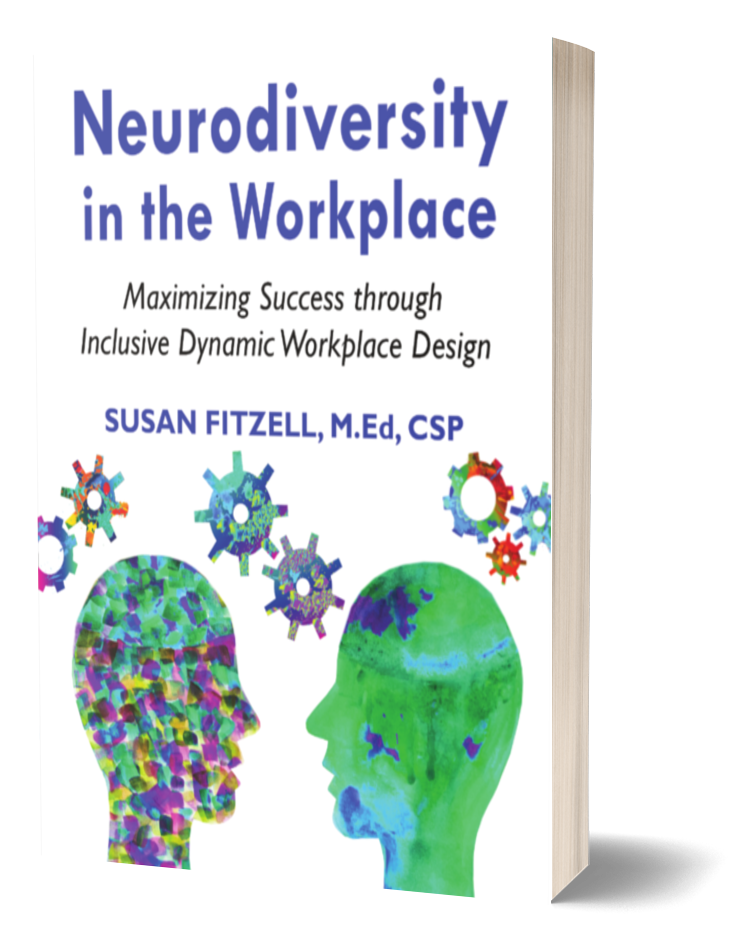 | CLICK HERE to learn how to Maximize Success in YOUR workplace!. Bring Susan to your organization! |