A Practical Guide for School Administrators
School administrators often ask me what co-teaching should look like. It is a fair question. Assessing a collaborative classroom is especially challenging for administrators who are new to the concept of co-teaching.
Too often, schools use what I call the dumped-in method of co-teaching. Teachers are simply dumped into it without support or training. The result is predictable. You walk into a classroom and see one teacher teaching while the other teacher stands in the background waiting for permission to work with students. Some specialists feel like they are just holding up the wall.
That is not co-teaching.
Administrators need to view co-taught classes as classes taught by two essential teachers working as one team.
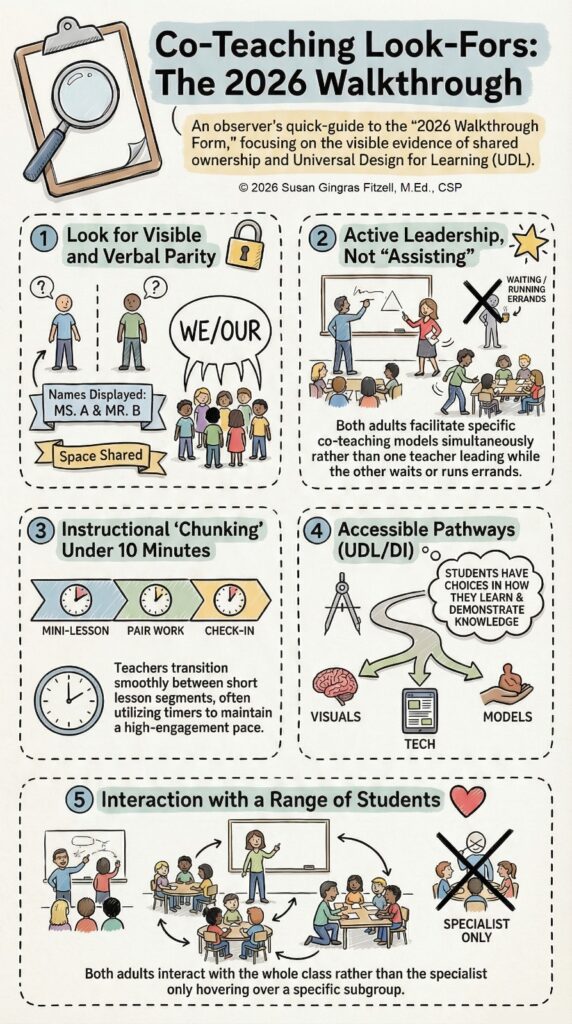
To help school leaders observe and support these teams, I have developed the 2026 Walkthrough Form. It provides a non-evaluative snapshot of classroom practice for administrators. It moves beyond vague theories and focuses on the practical realities of the classroom.
Here is exactly what you should look for when you walk into a co-taught class.
Specific Implementations
Observers should look for clearly defined roles. General approaches are no longer enough. I have detailed two dozen specific co-teaching implementations. Look for targeted strategies like Two Facilitate Speed Partnering or One Teach and One Summarize. There should be absolutely no doubt as to what each person is doing during a lesson.
Shared Ownership and Parity
Both adults must actively contribute to instruction and student engagement. They do not have to look identical to demonstrate parity. They also do not both need to be content experts. You should see them share ownership of the class through their actions, language, or leadership. Both names should be displayed, and the physical space must be shared. Furthermore, both adults should interact with a range of students, not just one subgroup.
Chunking Lesson Plans
Look at the clock. Teachers should transition smoothly between short chunks of instruction. Ideally, these chunks are ten minutes or less. The most effective time managers use timers to stay on track. This maximizes student engagement and keeps both teachers actively involved.
Stop Guessing, Start Teaching:
Introducing the Co-Teaching Lesson Plan Builder
Student Access and Differentiation
Are students engaged and clear on what they are expected to do? Teachers need to provide multiple ways to learn content. This might look like visual interpretations, graphic organizers, or technology like backchanneling. Students must also have choices in how they demonstrate their learning. Furthermore, teachers should be using formative assessments, like exit cards or Oral K-W-L activities, to guide immediate instruction.
Data and Flexible Grouping
Notice how the students are grouped. Students should work in intentional mixed-ability groups for practice. They might also work in targeted same-ability groups for review and enrichment. You should also see teachers collecting objective data on student behavior and understanding to guide future instruction.
Effective co-teaching is a partnership. It requires communication, persistence, and mutual agreement. This new walkthrough form gives you the framework to support your teachers in that work. It helps you focus on what matters most.
Access the 2026 Walkthrough Form by clicking here.
It is imperative that administrators understand what co-teaching is and what it is not. Also, it’s important to coach and mentor your staff in a positive, productive way to achieve the best possible results while making it clear that collaboration is not optional.
Frequently Asked Questions About Co-Teaching
What does effective co-teaching look like in a classroom?
Effective co-teaching involves two educators actively sharing instruction, planning together, and engaging students through clearly defined roles and strategies.
What are the most common co-teaching mistakes?
The most common mistake is the “one teach, one assist” default, where one teacher leads and the other becomes passive. Lack of planning and unclear roles also limit effectiveness.
How can administrators evaluate co-teaching?
Administrators should use structured observation tools that focus on parity, student engagement, differentiation, and data-driven instruction rather than general impressions.
 | CLICK HERE to discover a wealth of co-teaching strategies and resources to maximize student success!. Bring Susan to your campus!Featured seminar – Best Practices in Co-teaching and Collaboration: the HOW of Implementing the Models |