The moment is painfully familiar: you’ve repeated a direction three times, and your student or child is still staring blankly. You immediately think, ‘They just aren’t listening.’ But what if the problem isn’t ‘won’t listen’ but ‘can’t process’?” If we want to support students with Auditory Processing Disorder (APD) effectively, we must shift our focus from behavioral compliance to auditory processing strategies.
The APD Shift: Why It’s Wiring, Not Willpower
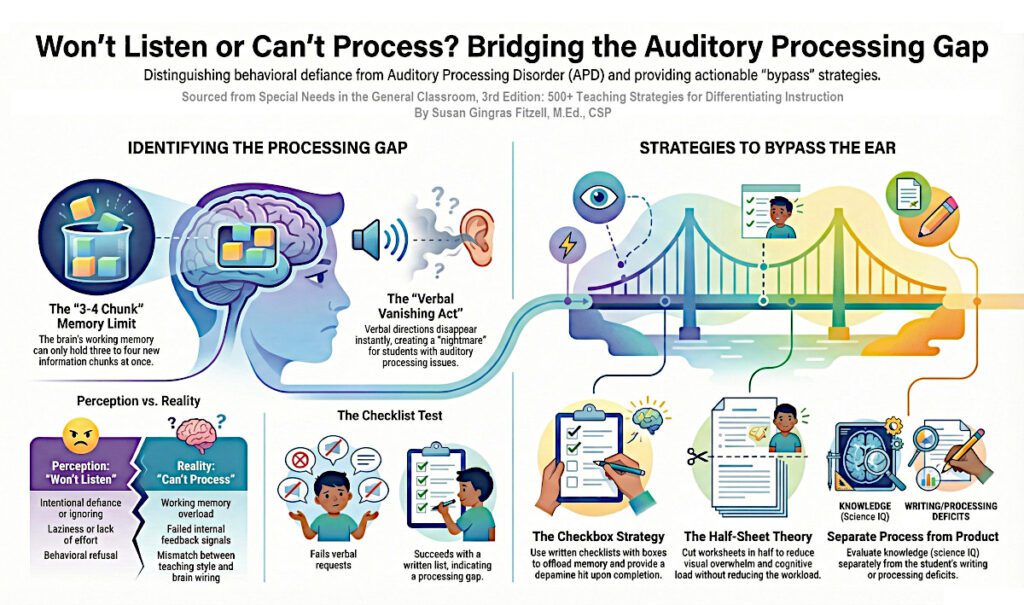
We have to start by looking at the biology of the brain rather than the behavior of the child. Research tells us that the brain’s working memory—essentially the brain’s sticky note—can only hold about three to four “chunks” of new information at one time.
If you give a child five verbal instructions in a row, and they only do the first three, they aren’t necessarily being defiant. Their working memory literally dropped the last two. The feedback signal in their brain failed, and the system collapsed. This is often the case for students with ADHD or auditory processing issues. They may be physically hearing the sound of your voice, but they cannot process the meaning effectively, especially if there is background noise.
To tell the difference, I recommend a simple test: Change the input method. If a child “ignores” a verbal request to clear off their desk, put their homework in their backpack, and get ready to meet the bus but immediately responds to a checklist or flowchart, it is not a behavioral refusal. It is a processing gap. We have to stop blaming the child for a mismatch between how we teach and how they are wired.
Bypass the Ear: Visual & Tactile Strategies That Stick”
If I had to give parents and teachers a life hack for giving directions that actually stick, it would be this: Minimize verbal instruction and emphasize using visual and tactile cues (often accompanying verbal instruction.)
When we give verbal directions, they vanish the moment we say them for students with APD. For a child who struggles with processing, this is a nightmare. Instead, use effective auditory processing strategies that bypass the ear. I call this the “Checkbox Strategy.”
Write the directions down in a specific way. Use a checklist format with empty boxes next to each step. This works for two reasons. First, it offloads the information from their overwhelmed working memory onto the paper. Second, the act of physically checking off a box gives the brain a small dopamine hit. It feels good to complete a task.
Additionally, use the technology you already have. If your child is watching TV, turn on the Closed Captioning. This associates the written word with the auditory sound and reinforces language processing without you having to say a word. Using effective auditory processing strategies can make the difference between success and failure.
Shifting the Narrative: From ‘Failure’ to ‘Strategist’
It is heartbreaking to watch a bright child begin to believe they are “stupid” simply because their brain processes information differently than their peers. I speak to you not just as a professional, but as a mother who has walked this path.
My son, Ian, was diagnosed with Central Auditory Processing Disorder (CAPD) and dyslexia. Teachers told me he didn’t belong in honors classes and that he was an “overachiever” who was working too hard. If we had accepted that label, he might have given up. Instead, we focused on “double dosing” his instruction and honoring his unique learning preferences. We didn’t lower the bar; we just increased the support. Because he learned how he learns, he went on to earn a mechanical engineering degree.
We must shift the narrative from “I can’t learn” to “I need a different strategy.” When a child realizes they can succeed when the format changes, that internal voice changes from “I am a failure” to “I am a strategist.”
Reducing the Homework Battle
Finally, we need to address the battleground of homework and grading. We must separate “process” from “product.” If a child knows the science concepts but struggles with writing, and we fail them on a written test, we aren’t measuring their science IQ. We are measuring their writing deficit.
For homework, I recommend the “Half-Sheet Theory.” It is a simple psychological hack. Take a worksheet, put the content on the front and back of a half-sheet of paper, and cut it. When a student sees a full page of math problems, they often shut down. When they see a half-sheet, they think, “I can do this.” It is the same workload, but the visual presentation reduces the cognitive load.
By using these strategies, we build a bridge between the student’s potential and their performance.
FAQ
1. How can I tell if a student “won’t listen” or genuinely “can’t process” verbal directions?
For students who consistently miss multi-step verbal directions but succeed when you switch the input method, it’s likely a processing gap, not defiance. Try giving the same direction two ways; first verbally, then as a written checklist or simple flowchart. If performance improves immediately with the visual support, you’re seeing a mismatch between how you’re delivering information and how their brain processes it, not a behavior issue.
2. Why do multi-step directions fall apart so quickly for some students?
Working memory can only hold a small amount of new information at once (often about 3–4 “chunks”). So, when you give five verbal steps in a row, the student may retain only the first few and “drop” the rest, especially with background noise, attention challenges, or auditory processing difficulties. The fix is reducing load and changing the format.
3. What are the most effective auditory processing strategies when verbal directions don’t stick?
Use strategies that “bypass the ear” by pairing brief verbal cues with visual and tactile supports. A high-impact option is the Checkbox Strategy; write steps in a checklist with empty boxes so the student can offload memory to paper and track completion. Keep directions short, concrete, and sequenced. The goal is durability, directions that remain visible after your voice is gone.
4. How can closed captions help with auditory processing?
Closed captioning links spoken language to printed words in real time. That pairing reinforces language processing and comprehension without adding more instruction from you. It’s an easy, built-in support at home and in classrooms using video: captions help many students “catch” what their ears miss, especially in noisy environments or fast speech.
5. What type of homework can I assign to reduce parent-child conflict?
Separate “how much work it is” from “how big it looks.” The Half-Sheet Theory keeps the workload the same but reduces overwhelm by shrinking the visual presentation. Print the work on a half-sheet (front & back if needed). This lowers cognitive load, increases willingness to start, and helps students experience momentum instead of defeat before they begin.
Call To Action
“Ready to transform your classroom or home? Stop the battle and start seeing results. Explore the books, workbooks, and training resources that have helped thousands of families find success.
Get More Strategies
- What to Do to Help Students Improve Focus
https://susanfitzell.com/what-to-do-to-help-students-improve-focus/ - Why Change Mindsets About Student Potential?
https://susanfitzell.com/why-change-mindsets-about-student-potential/
 | CLICK HERE to discover a wealth of teaching strategies and resources for maximizing student success!. Bring Susan to your campus!Featured seminar – Differentiation Strategies to Reach ALL Learners in the Inclusive Classroom |